
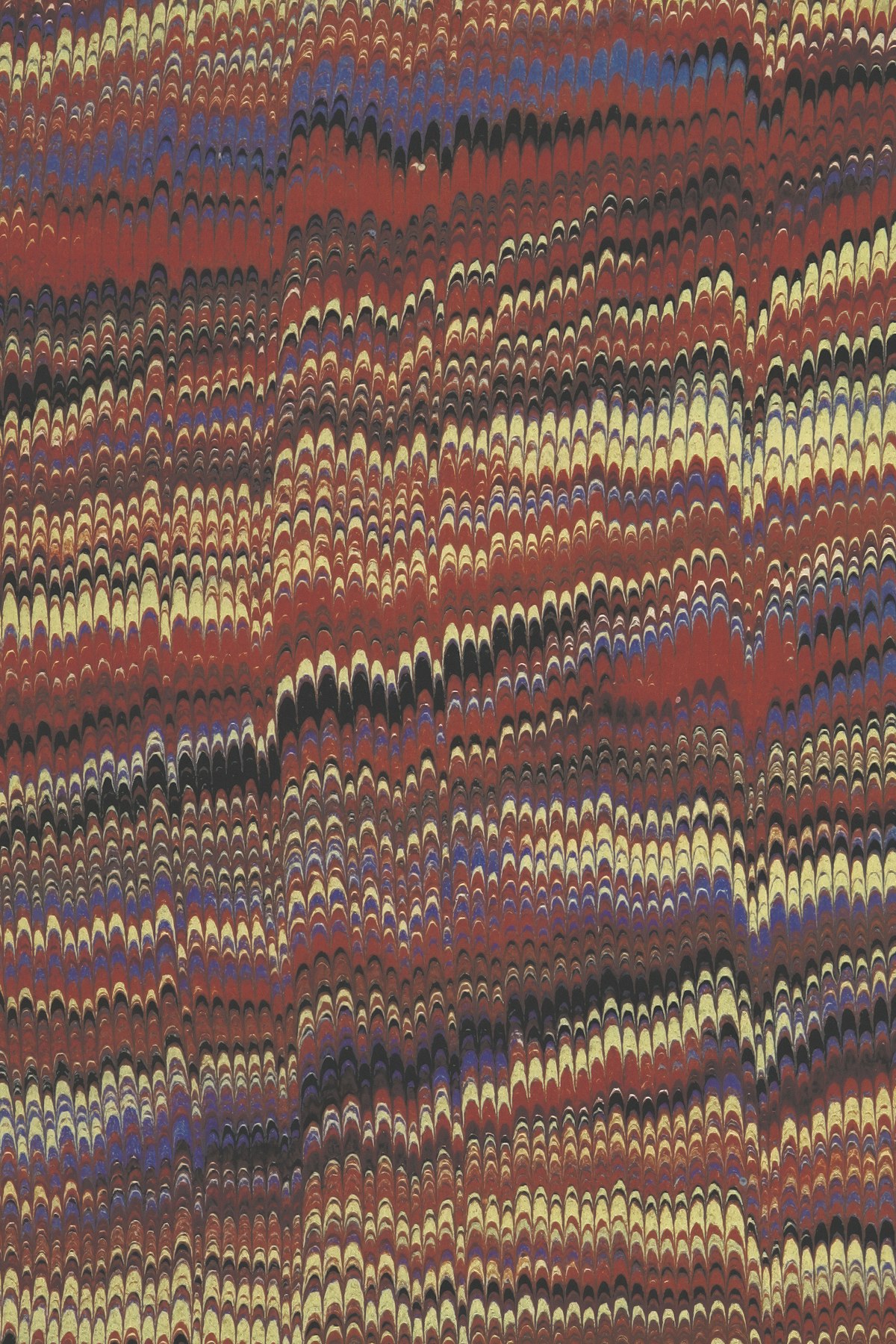
The Ancient Art of Hand Marbled Paper
Holly Thompson
The technique is centuries old. You lay pigments on the surface of size — a thick, viscous liquid — and move them with combs, styluses, or breath. Then you lay a sheet of paper across the surface and lift it away. What transfers is singular. It will never happen again in quite that way.
Nichola Daunton has been practising hand paper marbling for years. Her studio, Daunton Marbling, produces sheets that are used for bookbinding, stationery, framing and gifting — objects that carry the mark of a process that cannot be automated, cannot be hurried, and cannot be perfectly repeated.
Paper marbling arrived in Europe from Turkey and Persia in the 16th century, where it had been practised for at least two hundred years before that. It spread through the bookbinding trades, used as end papers in fine volumes, as wrapping for important documents, as a surface that announced care and intention. For a time it was everywhere. Then cheaper printing made it unnecessary, and it retreated into the hands of a small number of people who valued it for what it was rather than what it replaced.
The Heritage Crafts Association lists it as endangered. There are very few active practitioners in the UK.
What Nichola makes is not nostalgic. The patterns — combed, peacock, bouquet, chevron — are traditional, but the colour choices and the combinations she explores push the work forward. A sheet of her marbled paper is simultaneously very old and completely fresh.
Every piece is different. That is not a selling point. It is the nature of the craft itself.