Meet the makers
Every one named, every one placed, every piece told properly.

Daunton Marbling
Hand-marbled paper, double-marbled illustrations and chain garland kits. · North East LondonEndangeredMarbling is the kind of craft I used to assume was a museum thing. Endpapers in old books. Florentine notebooks in the gift shop. Nichola Daunton makes it feel current, and a little louder than I expected. From the Kent coast to north east London She works from a studio in north east London now, after years on the Kent coast, floating pigment on a prepared bath of size, drawing it into pattern with combs and rakes, then laying paper across the surface to lift the design off in a single pass. The mechanics are centuries old. The colour decisions are not. Nichola comes to marbling from a background in collage and illustration, and that shows in the palettes she chooses. Candy chevrons, deep-blue polka dots, snakes cut from double-marbled sheets. Nothing antiquarian about any of it. Marbling sits on the Heritage Crafts Red List as endangered, which is why I wanted her in the launch cohort. The technique is unforgiving. You get one chance per sheet, every sheet is a moment of weather on water, and the maker is only ever guiding pigment, never quite commanding it. That tension is the whole point, and you can read it in the patterns: an underlying order, and then something the paper decided for itself. One chance per sheet Her practice spans hand-marbled paper sheets in two sizes, paper chain garland kits that lean unapologetically domestic, hand-cut illustrations built from double-marbled stock, and giclée prints. She also runs marbling workshops, which feels important. The craft only survives if more people know how to do it. Everything she sells through The Haud is made-to-order, with a lead time of five to ten working days. No two sheets are alike. That is the offer, and it is the constraint.
Visit shop
Elyn Middleton
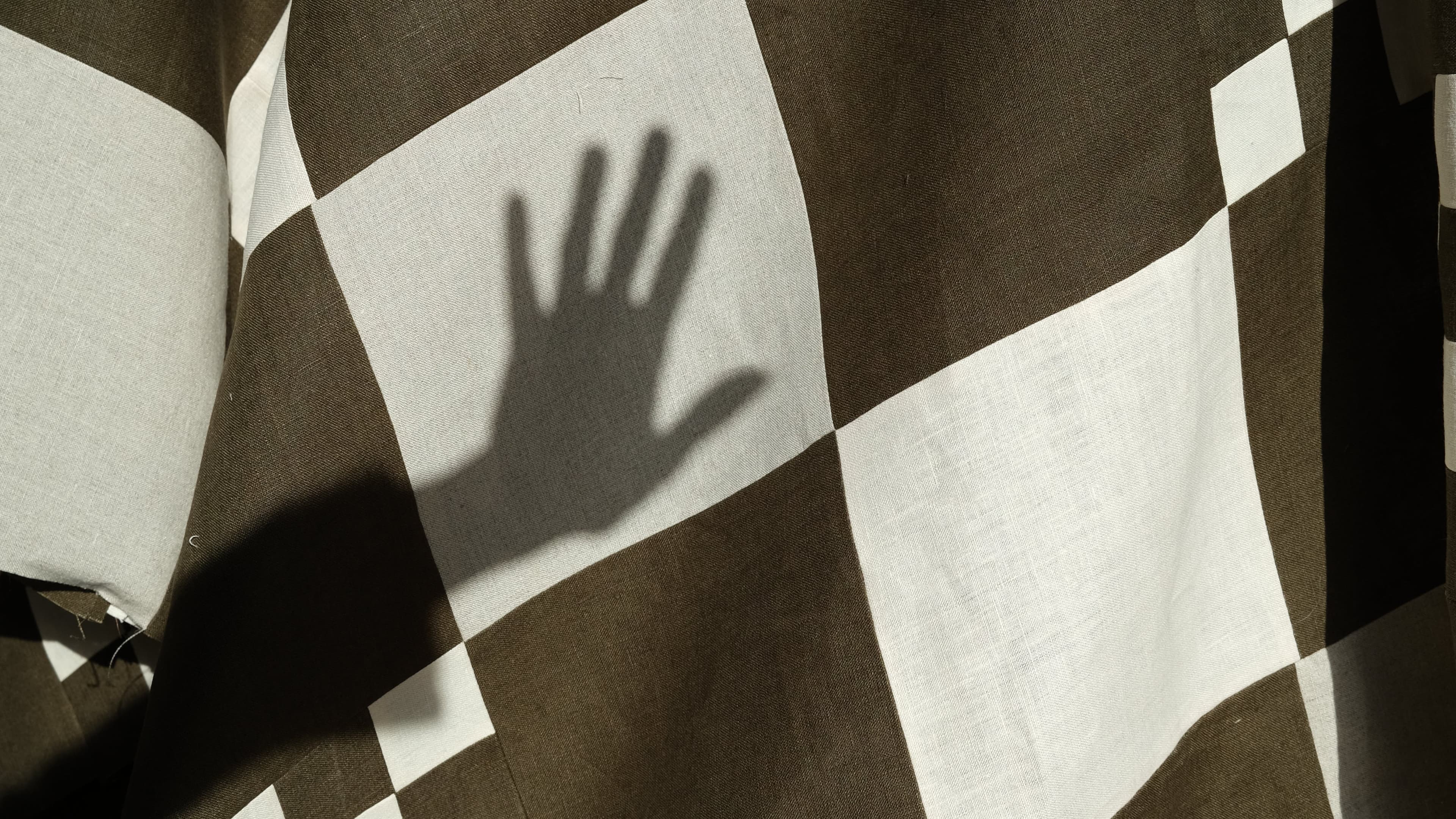
Hand-stitched patchwork quilts and quilted tapestries, made slowly in a Sheffield living room. · Sheffield, South YorkshireElyn (pronounced like Erin with an L) works in her living room in Sheffield. There is no separate workshop. Fabric stacks share floor space with the sofa, the cutting mat comes out in the evening and gets tidied away again before bed. "I work in my living room, so having a workshop would be a luxury," she told the Chuffed Store, and the constraint reads, to me, like the whole point. Her practice is called Slow Progress for a reason. The Bauhaus textile rooms What she makes is patchwork. Bed quilts large enough to live on, and smaller quilted wall hangings sized for a chimney breast or a stairwell. Machine pieced, hand quilted, hand-bound. The geometry comes first: blocks, stripes, checkerboards, the occasional half-square triangle off-axis to make the eye work for it. The colour palettes are restrained, mostly natural linen and warm cottons, the kind of palette you only get from someone who has thought about every seam. Elyn's influences sit firmly in the textile rooms of the Bauhaus and Black Mountain College. Sophie Taeuber-Arp, Anni Albers, Gunta Stölzl. In her own words, "pioneering textile artists who pushed age-old craft into a new era and really knew their way around a complex geometric pattern." She means it as a working brief, not a name-drop. The shapes in her quilts owe more to a 1920s wall hanging or a Modernist building elevation than to anything you would see in a contemporary patchwork magazine. A walk past a post-war block She also looks at architecture. "Architecture. Usually, but not exclusively, Modernist and post-war buildings," she says. "I find the sculptural forms fascinating as a whole, but it's the little details that get me. Decorative patterns, material textures, the quality of light." A long meander past a post-war housing block and a notebook full of pattern ideas is a normal afternoon. A quilt from Slow Progress is meant to be used. Slept under, hung on the wall above the bed, washed cool, ironed with steam, kept for decades and passed on. Elyn believes, plainly, that beautiful objects belong in everyday life.
Visit shop
Jessica Linley
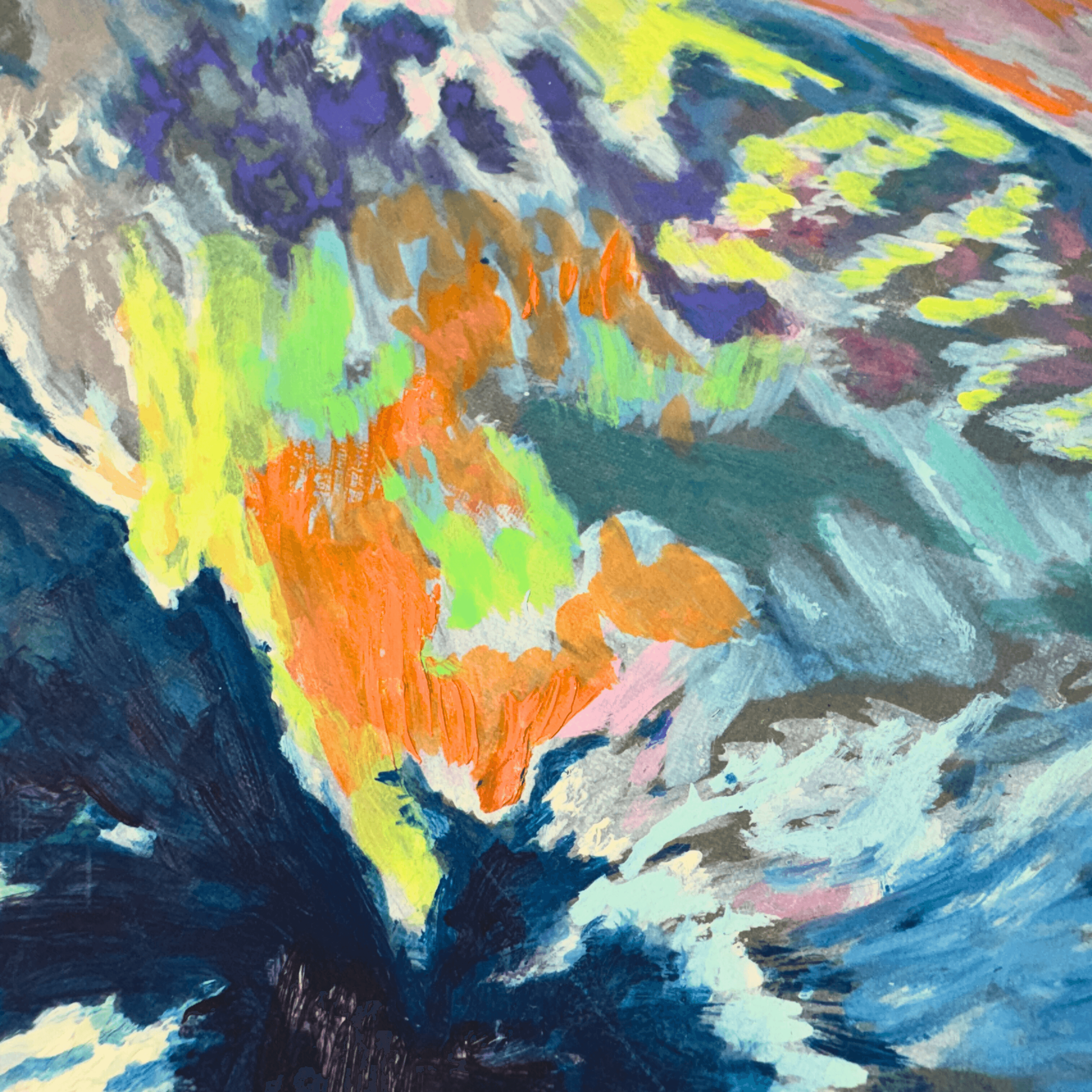
Abstract oil paintings, colour-led, made one at a timeJessica Linley paints in oil and works small. Five pieces on her shelf at the moment, none larger than 40 centimetres on the longest side, each one finished and set aside before the next begins. She paints on board and on panel, sometimes building a still life through fractured planes that almost cohere, sometimes letting colour move first and form catch up. The work is abstract in the strict sense: nothing in it is asking to be identified. Restraint inside the colour What that means for the room these paintings end up in is harder to say in advance. "Traces in Twilight" sets neon green against dusky blue and grey, with a muted red carried along the edges. "Refigurement 1" reads almost like a still life seen through cracked glass, planes overlapping until the objects underneath go quiet. "Drift Between Colour" lets colour move instinctively and stops where it wants to. The titles do a lot of work in setting up where each piece sits emotionally, and Jessica leaves it there. She does not over-explain. I came across her work through The Haud's open process and what struck me first was the restraint inside the colour. There is a temptation, in abstract painting at this scale, to make everything loud. Jessica's pieces hold a quieter register inside the brighter passages: a piece of muted red tucked behind the green, a grey layer that the eye finds only on second viewing. The brushwork is expressive without being theatrical. Each painting is one of a kind, signed, and sold unframed so a buyer can choose how to set it. The studio scale here is small. These are paintings you live with in a hallway, above a desk, propped on a mantelpiece. They are not statement pieces in the auction-house sense. They are something else: small, finished, considered, and entirely her own.
Visit shop
Joshua Lea
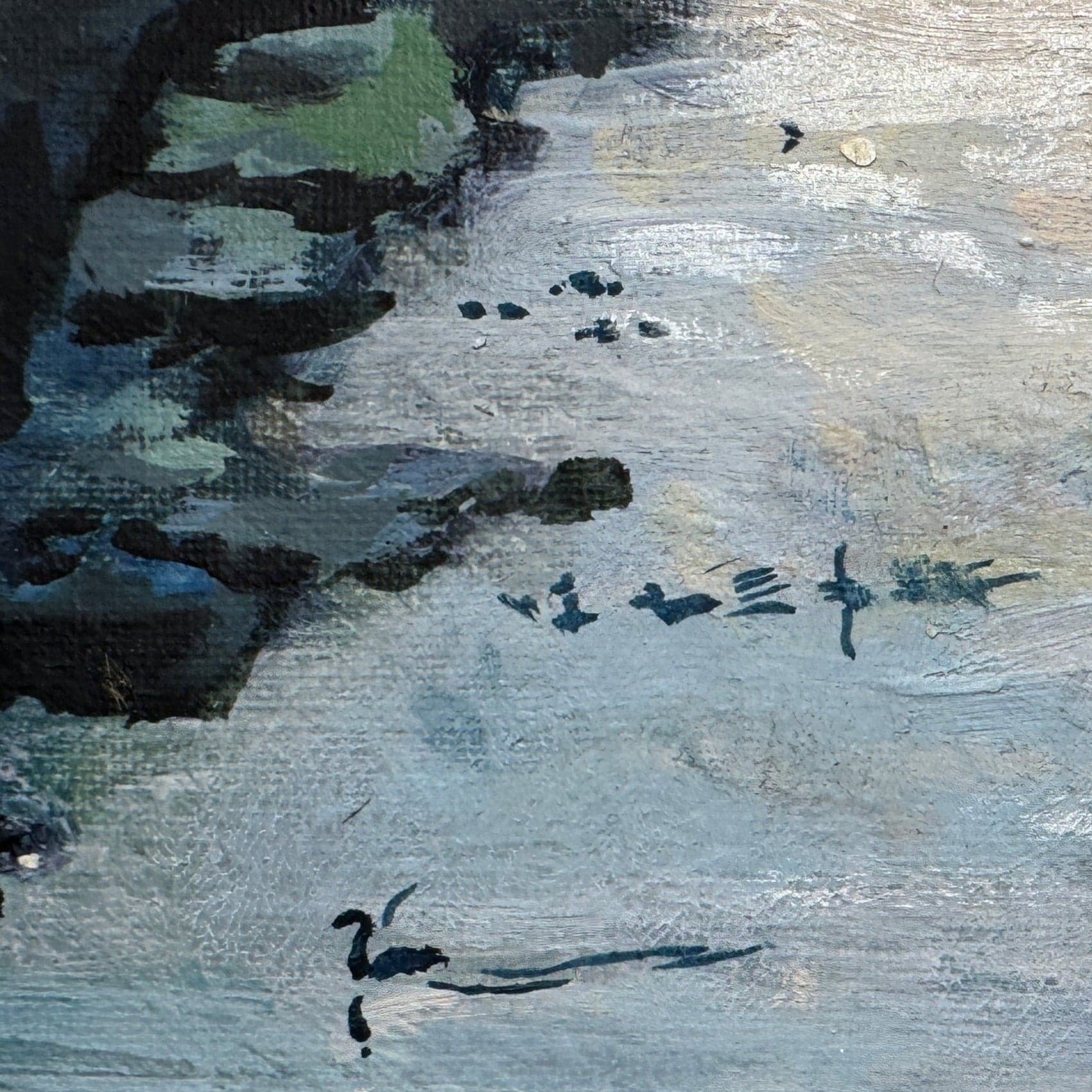
Romantic British landscapes in oil paint, from Thames scenes to the Solway coast. · LondonJoshua paints the British landscape the way the eighteenth century taught us to look at it. Not as documentary, not as backdrop, but as weather and water and the particular slant of a winter afternoon. Constable kept returning to the Stour; Joshua keeps returning to the Thames between Kingston and Hampton Court. Places you could walk to His subjects are almost all places you could walk to in a morning. Canbury Gardens at low tide. Steven's Eyot from the towpath. Teddington Lock at the boundary where the river stops being tidal. Pen Ponds at dusk with the deer settling in the bracken. Ham village across the meadow. The Solway coast on holiday. A watercolour of Slovakia from a stretch of countryside that caught him. What sets him apart in the work itself is the layering. He uses oil paint the way the great English landscape painters did, building up colour patiently rather than going for a single confident statement. The brush marks accumulate. The light gets carried by accident as much as design. You end up with paintings that feel observed rather than performed, which is harder than it sounds. Painted in front of the river Almost all of his work is hand painted en plein air. He carries the panel out, sets up at the location, and paints the scene in front of him before the light shifts. It is the unfussy method that gives the work its honesty, and it is also why each piece carries a date and a place rather than a concept. He also paints miniatures, often on 10cm boards, and takes commissions from a photograph of a landscape you love. The miniatures are not studies for larger works; they are finished paintings in their own right. The commissions are loose and romantic rather than photorealistic, which means you receive a painting, not a print of a memory.
Visit shop
Lucy Hook-Child
Hand-plaited corn dollies and harvest tokens, made in Layer de la Haye from heritage straw. · Layer de la Haye, EssexEndangeredLucy works in straw, which is a sentence that does not begin to describe what she does. Corn Dolly Making and Straw Work both sit on the Heritage Crafts Red List of Endangered Crafts, the conservation register kept by Heritage Crafts for traditional skills at risk of dying out in the UK. Lucy found that out in 2023, and started plaiting again that year. The Belchamp Walter line She grew up in rural north Essex, learning the basics in primary school in Layer de la Haye from a teacher called Keith Pettit. The lessons stuck. So did the family story: two of her third great-grandaunts were straw plaiters in Belchamp Walter, on the Essex-Suffolk border, in the mid-1800s, when straw plaiting was a household economy across that stretch of country. Hats, mostly. Lucy is taking it up again, three generations later, in the village a few miles over. She has a BA (Hons) in 3D Design Crafts and is a member of Straw Craftsmen, the body that holds the standard for the craft in Britain. From her studio in Layer de la Haye she plaits Welsh Border Fans, Spiral Drop Dollies, Cornucopia, Sun Wheels, Bridgid's Crosses, Lovers' Knots, Countryman's Favours and Glory Braids in flat and raised diamond variants. The shop on The Haud is one cross-section of that range; everything ships made to order, plaited by hand after you place it. Straw Club, on the road What she is also doing, alongside the work, is teaching. She founded Made, a creative collective in Colchester, and now hosts Straw Club at the East Anglian Folklore Centre, taking the skills out to anyone who wants to sit down and try. You will find her at Plough Days and Steam Threshing Days across East Anglia, plaiting in front of people who remember the older shape of these things. When I came across her work I thought first about the lineage, then about how easily this could have been lost. There are not many people doing this in Britain. Lucy is one of them, and she is also the one trying to make sure there are more.
Visit shop
The Bumbling Basketeer
Oak swill baskets and hand-bound brushes, made in rural Perthshire. · Crieff, PerthshireCritically endangeredSimon Cooper is the only oak swill basket maker left in Scotland. That is not framing; it is the inventory. There are perhaps a handful of practitioners across the whole of the UK, and the craft sits on the Heritage Crafts Red List as critically endangered. The work he does in a small workshop in Crieff, Perthshire, is what stands between this tradition and the end of it. Tattie baskets, by another name Oak swill is a southern Lake District form by origin. In Scotland the same baskets, made the same way, are called tattie baskets, after the potatoes they once carried. They moved coal onto steam ships. They went to market and to the hen run and out onto the riverbank with anglers. The lore goes that apprentices tested a finished basket by standing in it. Simon repeats this with the caveat that he wouldn't recommend trying it. The process is slow. Coppiced oak is split along the grain, cleaved into thinner and thinner strips, dressed, boiled, and then woven while still wet around a peeled hazel rim. A peeled hazel handle is bent in. On some pieces a willow hoop goes through the rim too. Nothing is glued. Nothing is nailed. The basket holds because of the way it is woven. Brushes on the wall When he isn't weaving, Simon hand-binds brushes and brooms (broomcorn, tampico, arenga), wrapped in coloured cord against an oak bark tanned leather handle, often with a thin woven oak strip inset as a nod to the swill work. They are made to hang on the wall, not to be put away in a cupboard. The brand name is Simon's. He calls himself The Bumbling Basketeer, which is the kind of joke a person makes when their work is so precise that the joke is the only safe distance from it.
Visit shop
Tightrope Knots
Hand-spun cotton, flax and dead-stock rope, twisted into dog leads, doorstops and juggling balls. · Cambridge, CambridgeshireEndangeredGem Bowes is one of a small handful of people still making rope by hand in Britain. She works out of a Cambridgeshire workshop, hand-spinning cotton, flax and dead-stock yarn into something useable: a lead for a Labrador, a doorstop with the weight of a small dumb-bell, a set of juggling balls that will probably outlast their first owner. Learned on Arthur Beale's floor Her route in was theatrical. She read for a BA in set building at the Royal Central School of Speech and Drama, threaded three years of student and fringe theatre in Edinburgh through the side of that, then spent nearly seven years at Arthur Beale, the Shaftesbury Avenue chandlery that had been making rope and ship-fittings since the 1500s before it closed its physical shop. That is where the rope work came from. She learned it on the floor, surrounded by sailmakers' tools and brass blocks, in a building that had been doing the same job for four and a bit centuries. Cambridge is home: born and raised there, recently relocated back. The workshop is the engine room and the leads are the steady seller, but she is open about wanting to make almost anything anyone can describe to her. "I love problem solving how to make someone's design ideas a reality," she told me, "and I might regret saying this but I don't think any idea is too crazy!" Bespoke is not a sideline; it is the appetite. Rope-making sits on Heritage Crafts' Red List of Endangered Crafts. There are very few practitioners left in the UK, and almost none working at this scale, by hand, in colour. The craft as Gem practises it is tactile and slow: each strand measured, looped, twisted with the right tension so the finished rope has a particular springy give. The work she does is, in the most literal sense, keeping a skill alive.
Visit shop