

The Haud Almanack: August Events
This one is late, and August has already taken one of its strangest days off the board. On the seventh the Burryman walked South Queensferry, nine hours of it, a man encased head to foot in thousands of burdock burrs with two attendants holding his arms out from his sides. He went a week earlier than usual this year to fit the school holidays. If you missed him, you missed him.
This one is late, and August has already taken one of its strangest days off the board. On the seventh the Burryman walked South Queensferry, nine hours of it, a man encased head to foot in thousands of burdock burrs with two attendants holding his arms out from his sides. He went a week earlier than usual this year to fit the school holidays. If you missed him, you missed him.
The rest of the month is the good part. Late August is when the folk calendar loses its manners: a man is burned in effigy in Wensleydale, a thirteen-foot cart of rushes is hauled round four Pennine villages, and a schoolgirl outside Bude is crowned on the site of a hermitage by a man whose real name nobody will tell you.
The conventional worry about all this is that nobody turns up any more. It is the wrong worry. There are something like 13,600 morris dancers in Britain, Saddleworth has more sides coming this year than in the whole history of the event, and the crowds are younger than they were ten years ago. The thin part is not the ritual. It is the making. Rush matting sits on the Heritage Crafts Red List as endangered, with somewhere between six and ten people in Britain taking their main income from it. The cart will roll on the twenty-second. The question is who dresses it in thirty years.
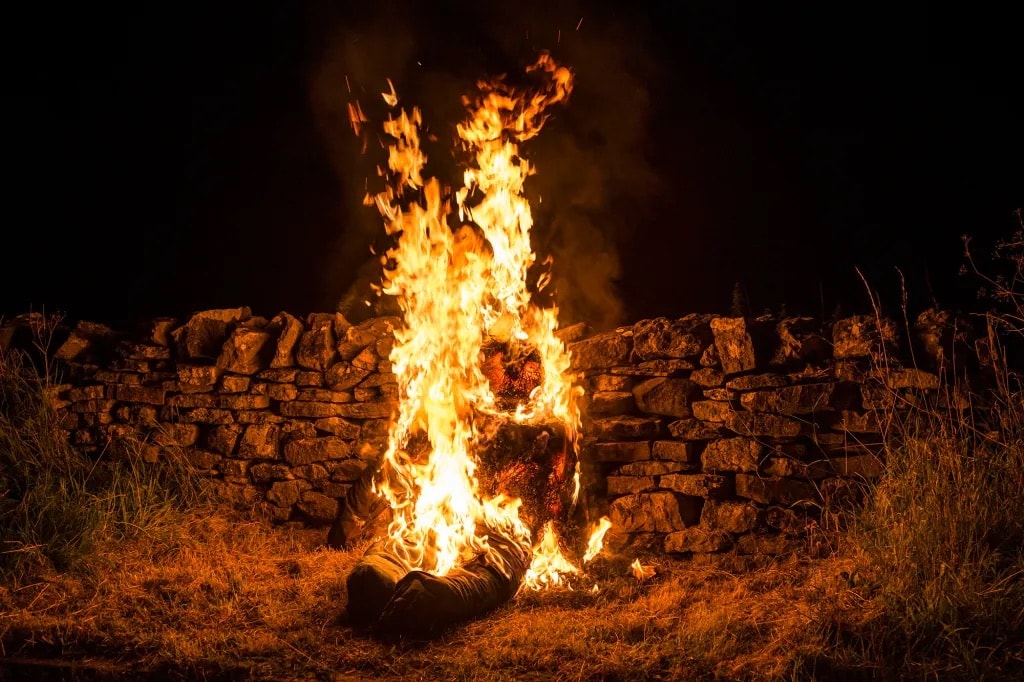
BURNING BARTLE
West Witton, Wensleydale, North Yorkshire. Saturday 22 August, from 9pm.
St Bartholomew has the parish church at West Witton, and on the Saturday nearest his day the village makes a figure and kills it. Bartle is a stuffed man, built like a Bonfire Night guy but wearing a hideous mask, and his eyes light up. At nine in the evening he is carried out and paraded down the village street, and the crowd goes with him.
The procession stops constantly. At each halt his attendants recite a verse that maps his last night onto the local landscape, place by place: "On Penhill Crags he tore his rags, Hunters Thorn he blew his horn," and on through Cappelbank Stee, Grassgill Beck, Wadhams End. Each stop ends with "Shout, lads, shout," and a few hundred people in a Dales village shout hurray. Then everyone moves twenty yards and does it again. It takes a while. At the end he is carried up a little road behind the houses, stabbed, doused and burnt.
Nobody can tell you who Bartle was. The candidates are the saint, a thief who stole the Penhill sheep, and a giant who lived up on the crags, and the village has never felt the need to settle it. The verse survives, but the identity does not.
The interesting bit is that Bartle is made new every year, because every year he is destroyed. There is a whole class of British making that exists in order to be burnt, ploughed in or thrown away: wicker figures, corn dollies turned back into the first furrow, the tar barrels at Ottery St Mary, the guys built for 5 November. None of it ends up in a museum case, because none of it survives the week it was built for. Which means there is nothing to reverse-engineer. With a chair or a coracle you can take the object apart and work backwards to the skill. With Bartle you cannot. If the last person in West Witton who knows how he goes together stops making him, there is no last year's to go and look at.
That is the Red List problem in miniature. The knowledge sits in a person, in one village, in one week of August, and it only passes on when somebody stands next to somebody else and watches them work. Which is an argument for going.
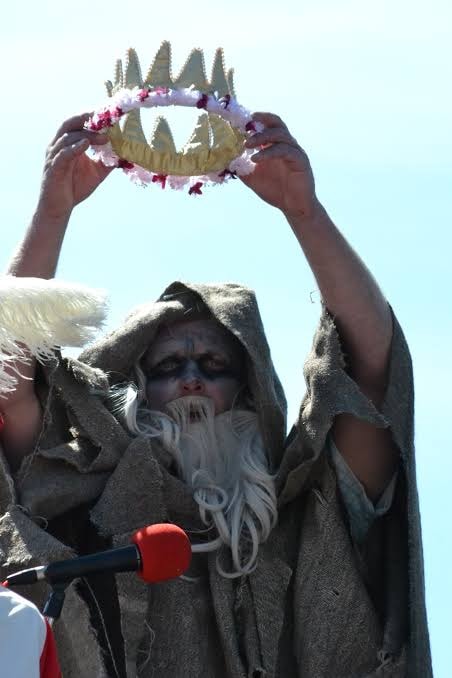
MARHAMCHURCH REVEL
Marhamchurch, near Bude, Cornwall. Monday 17 August.
The Revel falls on the first Monday after the twelfth of August, which puts it on the seventeenth this year, and it belongs to the children. The village schoolchildren elect one of their own as Queen of the Revel. She is crowned on the site of St Marwenne's hermitage, the sixth-century anchoress who gave Marhamchurch its name, by a figure called Father Time, whose real identity is kept from the children in the same spirit as Father Christmas.
Then she gets on a white horse. The procession follows her and her attendants through the village and out to the Revel Field, where the afternoon goes the way these afternoons go. It is small, and it is for the people who live there rather than for anyone visiting. Cornwall has far louder summer customs, Golowan among them. Nobody at Marhamchurch is performing for a camera, which is getting rare.
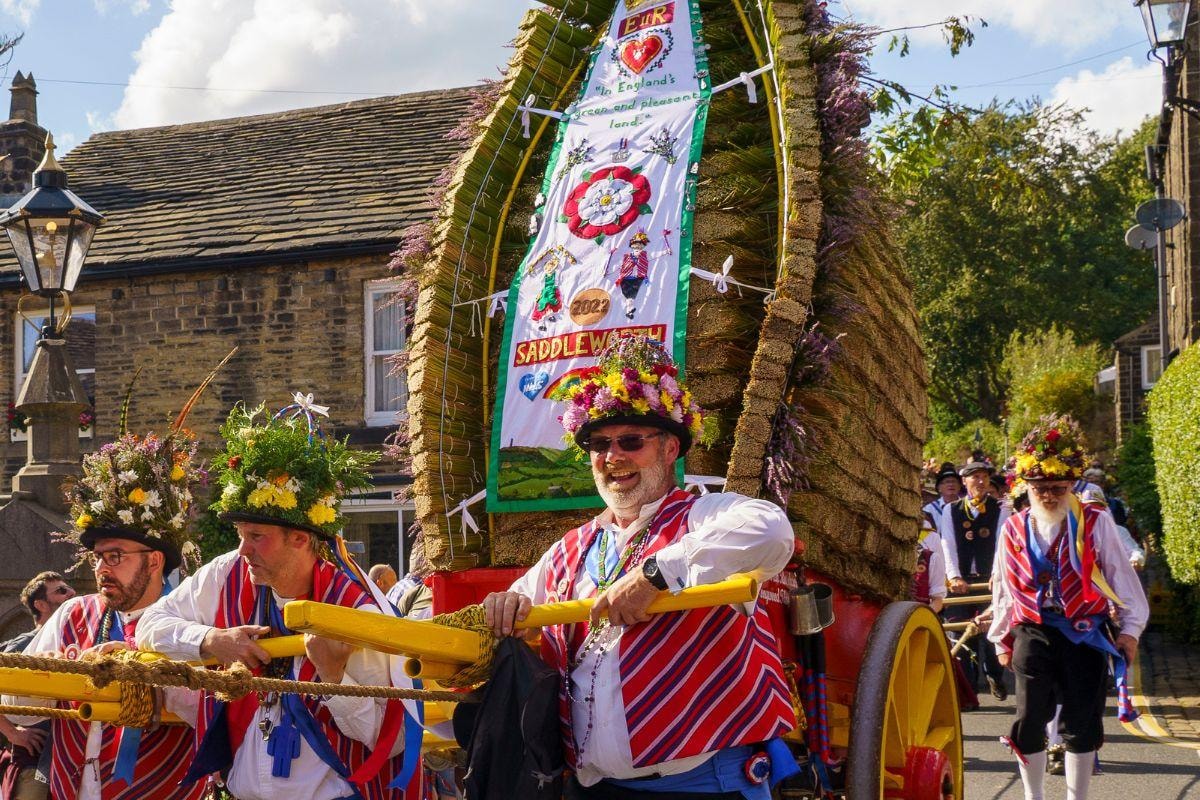
SADDLEWORTH RUSHCART
Uppermill, Greenfield, Delph and Dobcross, Saddleworth. Saturday 22 and Sunday 23 August.
Church floors were once strewn with rushes, and in the Pennines the rushes arrived by cart. Saddleworth still builds the cart: thirteen feet of rushes stacked and shaped and dressed with heather and rowan, with a jockey riding the top who is chosen from the Saddleworth Morris Men by how long he has been dancing. It is hauled by hand round four villages on the Saturday, from a quarter to ten in the morning until nearly seven, stopping at pubs to dance. On the Sunday it goes to St Chad's for the eleven o'clock service, and the afternoon is given over to gurning and a worst singer competition. Twenty-eight morris sides are coming this year, more than the event has ever had since it was revived in 1975.
Two things sit underneath that. Rush matting, the craft of cutting and weaving the stuff, is endangered on the Heritage Crafts Red List: six to ten full-time makers, rush increasingly hard to source, and a recruitment problem at both ends, weavers and cutters alike. And in 2024 the Morris Men had to appeal publicly for around £5,000 to cover the traffic management, marshals and first aid that the law now requires of them. Their Squire put it plainly: "if it gets to the point where we cannot pay the bills for the services we must have then I fear it will end." Twenty-eight sides, and a five thousand pound hole. Both of those are true at once.
GRASMERE LAKELAND SPORTS AND SHOW
Grasmere, Cumbria. Sunday 30 August.
More than a hundred and fifty years old, and still the fixed point of the Lakeland year: hound trails, fell races, tug of war, and Cumberland and Westmorland wrestling in the ring at the centre of it.
Watch the wrestling for the kit. The men wear white long johns with an embroidered velvet centrepiece over the top, and the embroidery is domestic work, made by the wrestler's mother or wife or partner rather than bought. What goes on it is farms: cattle, particular breeds of sheep, the things that family actually keeps. A wrestler's ancestry is stitched onto his thighs and then rolled in the grass. I cannot think of another sport in this country whose kit is a piece of household needlework, made at a kitchen table, handed on and repaired. The wrestling is the draw. The embroidery is the reason to get close to the ring.
WHAT'S ON
Three for the craft diary.
Heritage Crafts in conversation: Chrissie Freeth, tapestry weaver
Online. Tuesday 18 August, 7 to 8pm.
Freeth is an archaeologist turned tapestry weaver, and the conversation is about carrying a very old technique into work about small personal moments. An hour, from the kitchen table, for the price of a ticket.
Ould Lammas Fair
Ballycastle, County Antrim. The last Monday and Tuesday in August, so 31 August and 1 September.
Coming up on four hundred years old and one of the oldest fairs in Ireland, still with the horse trading, still selling dulse and yellowman. Confirm the timings with the organisers before you travel.
The Great Dorset Steam Fair, which is not happening
Tarrant Hinton, Dorset. Formerly late August.
Worth marking the absence. The national heritage show has not run since 2022, was halted on cost, and was put up for sale without finding a buyer; the organisers put the price of staging it at around five million pounds (BBC, November 2024). Enthusiasm was never the problem. Public liability, traffic management and insurance were. It is the same arithmetic that Saddleworth is doing on a smaller scale, and it is the reason a five thousand pound appeal is not a small story.
Cornwall, the Dales, the Pennines and the Lakes, all in a fortnight. If you get to any of them, write and tell me what you saw. I am particularly interested in whether anyone catches sight of Bartle being built.
Rosie
- 1
Marhamchurch, Cornwall, England, United Kingdom
- 2
West Witton, North Yorkshire, England, United Kingdom
- 3
Uppermill, Greater Manchester, England, United Kingdom
- 4
Grasmere, Cumbria, England, United Kingdom