

The Haud Almanack: October Events
Three October dates where a Red List craft is the reason to go: hand-painted rides at Yarm and Hull, and heavy horse collars at the National Ploughing Championships.
October is the month of the travelling fairs. The harvest is in, the hiring year has turned, and the showmen are on the road for the last big dates before they pull in for winter. This month I have picked three things to go and see, and each of them has a craft inside it that is now down to a handful of people. Two fairs in Yorkshire, where the rides are painted by hand, and a field in Warwickshire where heavy horses plough in collars that four people in Britain still make for a living.
YARM FAIR
High Street, Yarm, North Yorkshire. Thursday 15 to Saturday 17 October. The Riding of the Fair on Saturday at 11.30am, then the Blessing at noon (times to be confirmed).
Yarm has had a market since King John granted the charter in 1207, and its October fair grew out of it. A century ago it was famous for cheese: up to five hundred tons of it changed hands here in a single fair, along with the livestock driven in from the dales. The livestock sales ended in the 1970s. What is left is a funfair filling the whole of the wide Georgian High Street, and a set of old habits that nobody has thought to drop. The travellers start arriving on the Tuesday to build up. On the Saturday the Riding of the Fair goes up the street, an eighteenth-century horn is blown, and the fair is blessed at noon. Horses are still paraded up and down the High Street, and they move at speed, so keep to the side.
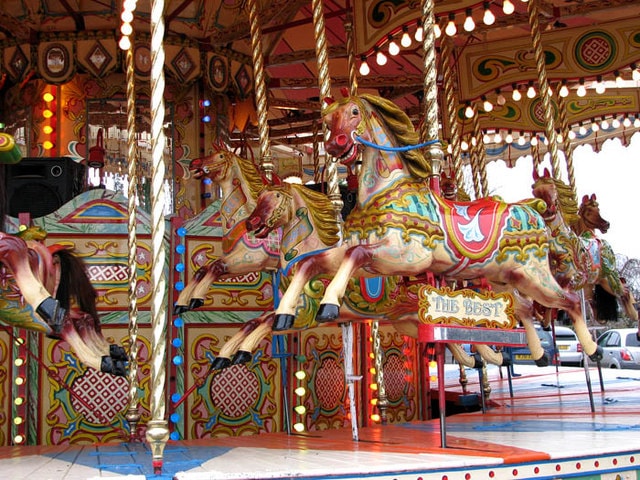
Look at the rides. The lettering, the scrollwork and the gold and silver leaf on the fronts is fairground art, and it is Endangered on the Heritage Crafts Red List. There are about eight people in Britain painting fairground rides commercially, and about ten more who do it for their own machines. It was a family trade inside the showmen's world. William Spilsbury of Bristol is one of the earliest names on record; after the war Fred Fowle set up in business with Billy Hall, and became one of the most influential painters the trade has had. The Red List is blunt about what nearly finished it. In the 1980s and 1990s vinyl lettering came in, it was cheap and quick, and a generation of painters never passed the skill on. Most people still cannot tell a hand-painted front from a sign-written one, and there is no formal training.
The painters working now include Joby Carter, Aaron Stephens and Amy Goodwin. I cannot tell you whose brushwork will be on the Yarm rides this year; the showmen will know, and I would like to. If you go, stand back from the lights for a minute and look at the paintwork in the corners of the ride fronts, where the leaf catches. That is somebody's hand.
There is a second craft that belongs to fairs like this one. The painted bow-top wagon, the vardo, comes out of the same Travelling world, and it is Endangered too: between ten and eighteen makers and knowledge keepers, building and decorating in ash, carving, gilding and hand-painted scrolls. Some of the threat is legal. The Red List notes that the 2022 Police, Crime, Sentencing and Courts Act has, in its words, effectively outlawed roadside living, and a wagon that cannot stop on the verge has lost its reason to be built.
BRITISH NATIONAL PLOUGHING CHAMPIONSHIPS
Austrey, near Atherstone, Warwickshire. Saturday 10 and Sunday 11 October. Gates open 8am.
This is the seventy-fifth championships, and around 250 ploughmen and women will be out across a hundred hectares, with conventional and reversible ploughs, vintage tractors, steam ploughing engines and heavy horses. Go for the horses. The horse classes run through the middle of both days, and the pairs work the furrows at walking pace in a way that makes everything else on the site look hurried.
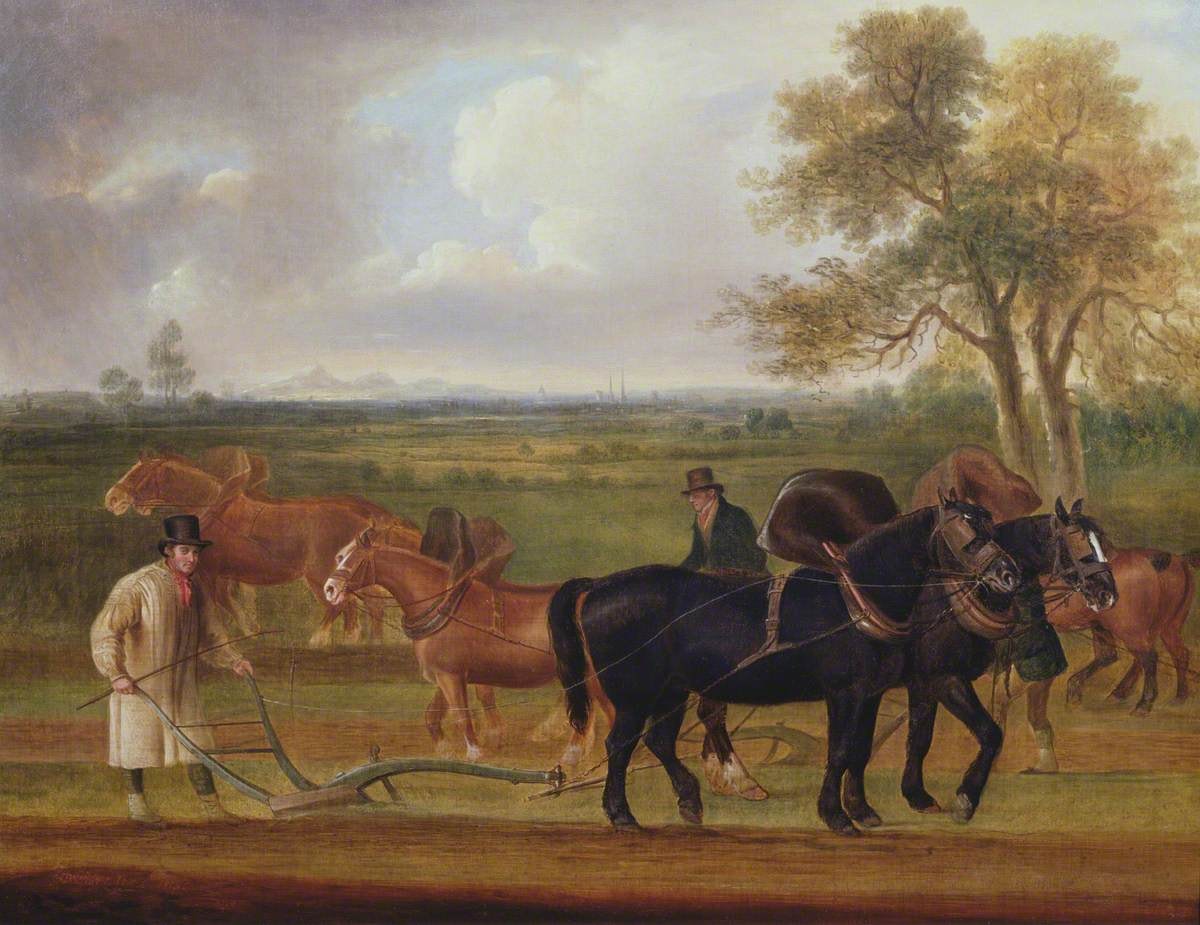
Every one of those horses is wearing a collar, and horse collar making is Critically Endangered, which is the last category on the Red List before extinct. Four people make their main living from it. A heavy horse collar is leather or serge over a body of rye straw, stuffed and then moulded with a mallet to fit one particular horse. Terry Davis in Shropshire makes twenty to thirty heavy horse collars a year. John McDonald and Kate Hetherington in Dulverton make driving collars. The rye straw is getting hard to find in Britain, cheap machine-made collars come in from North America, and two of the four professionals are close to retirement with no formal training anywhere to replace them.
HULL FAIR
Walton Street, Hull, East Yorkshire. Friday 9 to Saturday 17 October, closed Sunday 11th. Most days from 2pm, from noon on Saturdays.
Hull Fair goes back to a charter of 1279 and is now one of the largest travelling fairs in Europe, with more than 250 rides along Walton Street. It runs the week before Yarm, and much of what I said about the paintwork there applies here twice over: more rides, more fronts, more chances to see the hand-painted work next to the vinyl and learn to tell them apart. The traditional things to eat are brandy snaps and, for reasons nobody has quite explained to me, pomegranates.
- 1Hull Fair
Hull, East Yorkshire, Friday 9 to Saturday 17 October
- 2British National Ploughing Championships
Austrey, Warwickshire, Saturday 10 and Sunday 11 October
- 3Yarm Fair
Yarm, North Yorkshire, Thursday 15 to Saturday 17 October
Hull, Austrey and Yarm. If you know who painted a ride at either fair this year, or who made the collar on a horse at Austrey, please tell me. Those are the names I want to be writing down.
Rosie
Cover: John Faed, The Statute Fair, Wolverhampton Art Gallery. Public domain.