

The Bench | Claire Broad on marquetry and bespoke furniture
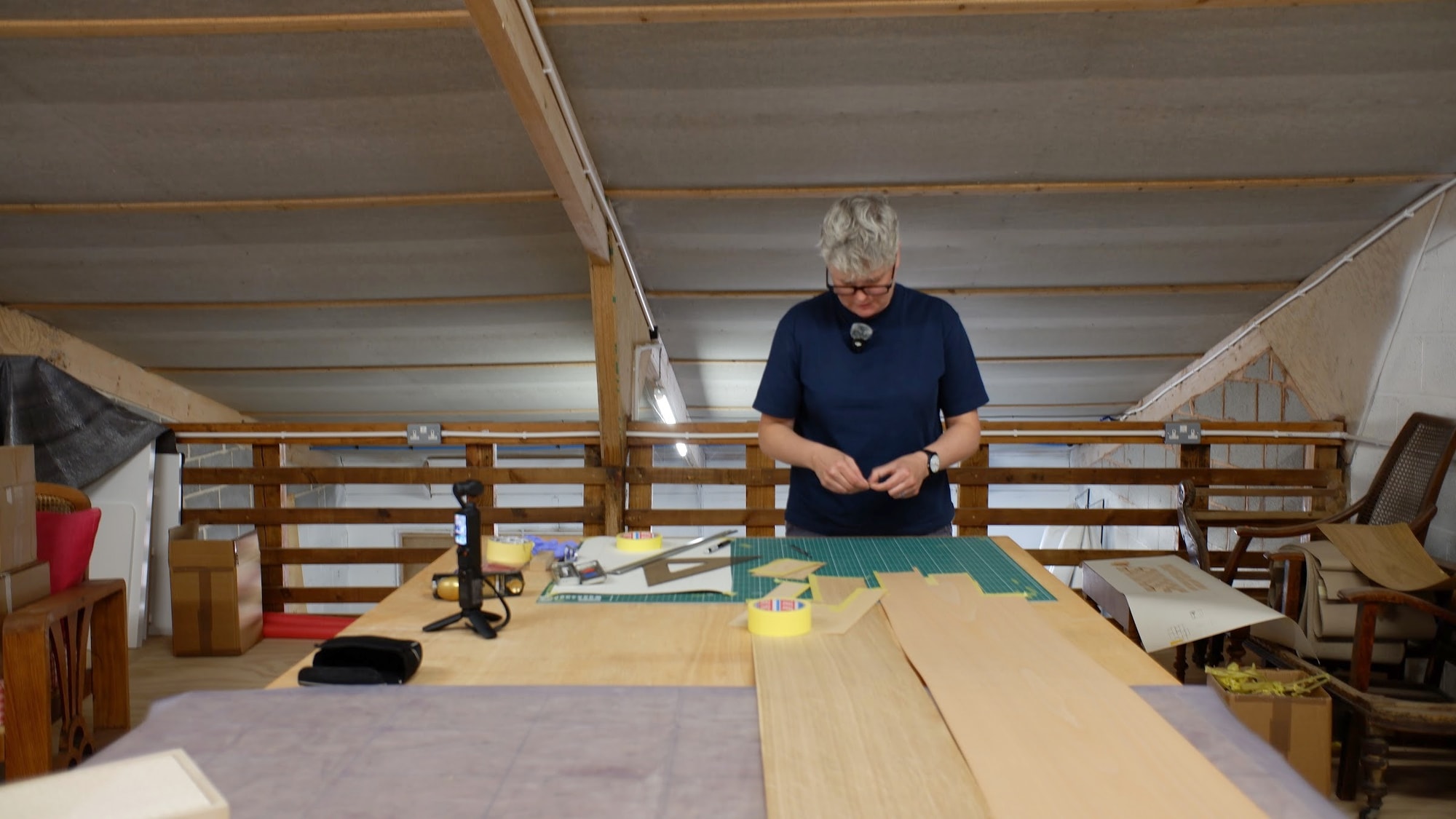
The veneer Claire Broad cuts her marquetry from is 0.6 of a millimetre thick, and she cuts every piece of it by hand with a surgical blade at a long table in the attic of her workshop on a farm in Staffordshire. When I visited on 1 October she cut a square of oak, held it up against her rule and checked it again, even though it had come off the cut square. "It should be square because it's been cut," she said, "but I never trust things that I haven't cut myself."
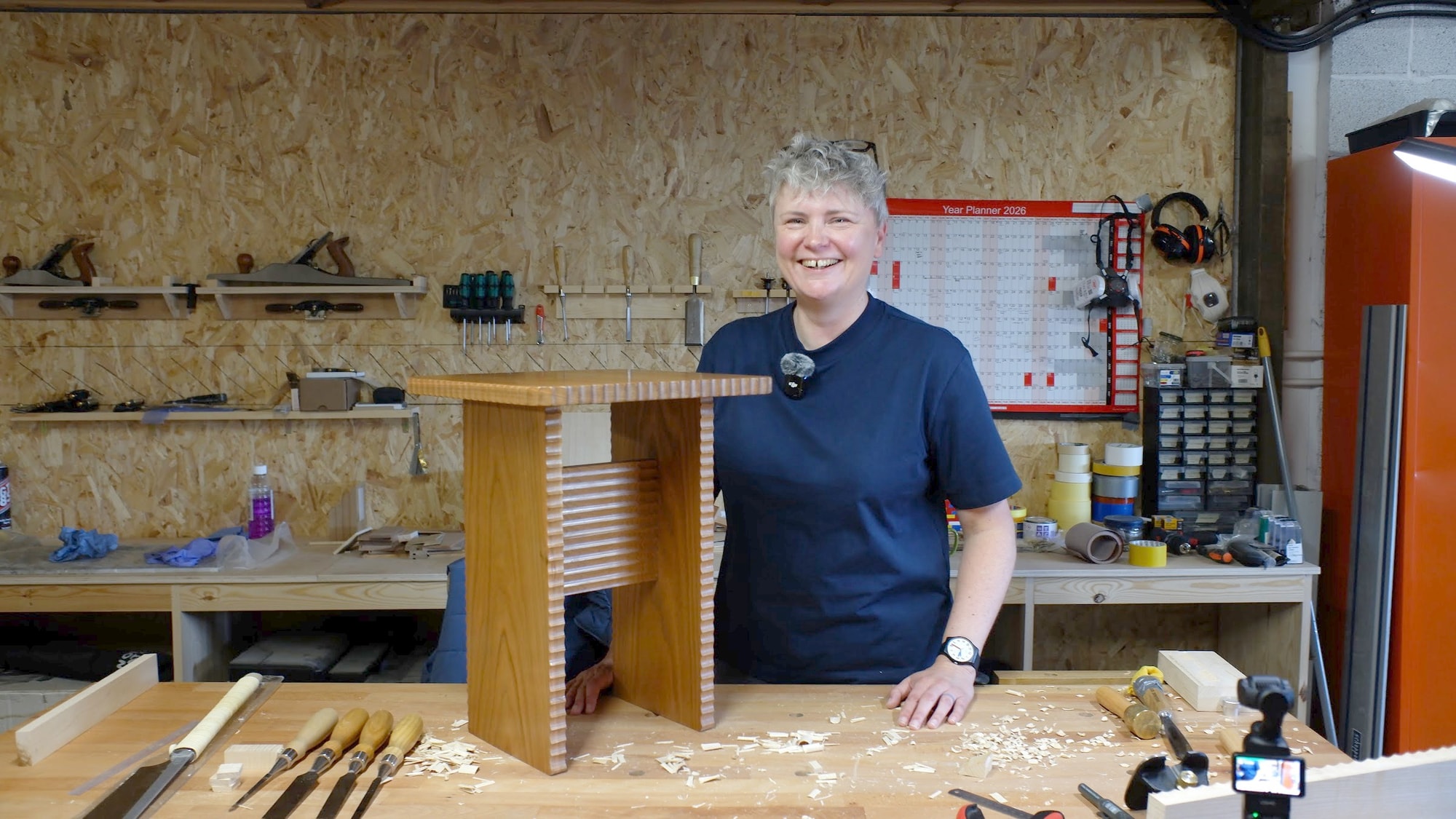
Claire makes small furniture, keepsake boxes and marquetry wall art, and she takes commissions for all of them, from a single box up to a cabinet.
FROM THEATRE DESIGN TO WATERS AND ACLAND
She trained as a theatre designer at Central Saint Martins and then as a joiner, spent a few years in office work, and then twenty years in product design and development in the corporate world. "I've always done making things, but I spent a long time in the corporate design world," she told me. "And then a couple of years ago, I decided that it was time to get back into actual making." In 2024 she retrained at the Waters and Acland Fine Furniture School in Cumbria, where the first term is all hand tools and traditional joints, and in 2025 she set up her own workshop.
The tutors there were exacting, and she still remembers the first box she made. "I was really, really pleased with it, and the tutor came along and rubbed his hands down the side and said 'did you sand this?', which obviously meant there was something not quite right to his eye." By the end of the course, she says, they could all see a quarter of a millimetre, "and so if anything was out by a quarter of a millimetre we were all very upset and had to redo it again."
She hadn't expected to like marquetry, and when the first table she made at Waters and Acland needed a marquetry top she went into it thinking she wouldn't be doing much of it. She ended up making her final piece with it too. That piece is the Stacks Console, an oak console table with three piston-fit drawers and a cupboard, inspired by early twentieth century architecture and the Bauhaus. She packed in every joint and construction she could while she had tutors on hand to help if something went wrong, and she still has it. "Probably not the most practical piece of furniture, but from a design perspective, I was really pleased with how it came out."
WHAT IS MARQUETRY?
Marquetry is the craft of cutting thin sheets of wood veneer into shapes and fitting them together, like a jigsaw, to make a picture or pattern that is then glued to a solid surface. It has been made in Britain since the seventeenth century. Heritage Crafts lists it as currently viable rather than endangered, though it notes an ageing membership and few young people taking it up. Claire likes it because it adds another level of design to a piece of furniture: "you've got the structure, you've got the construction, you've also got the timber which brings the design, but then obviously you can layer on the artwork."
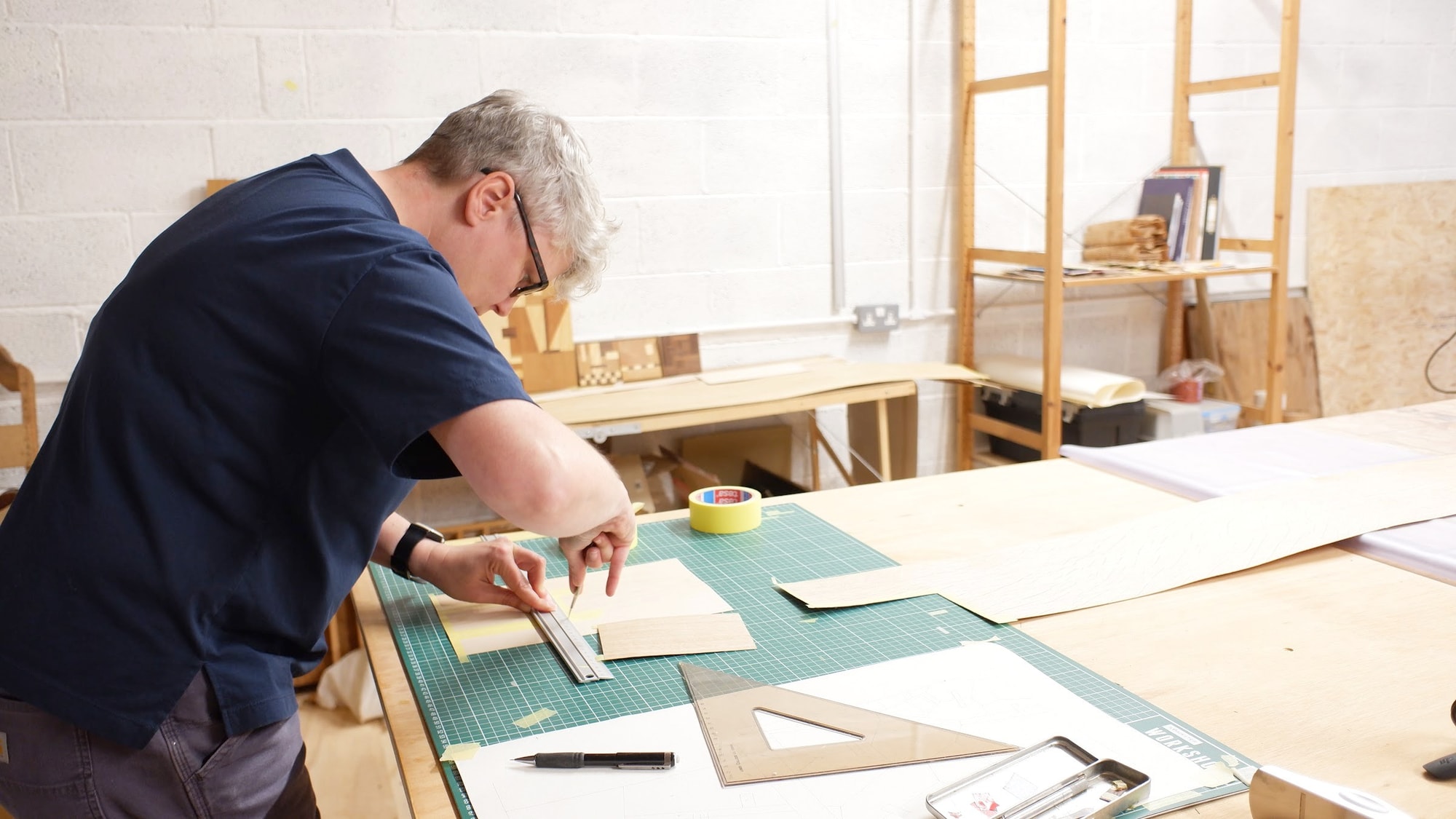
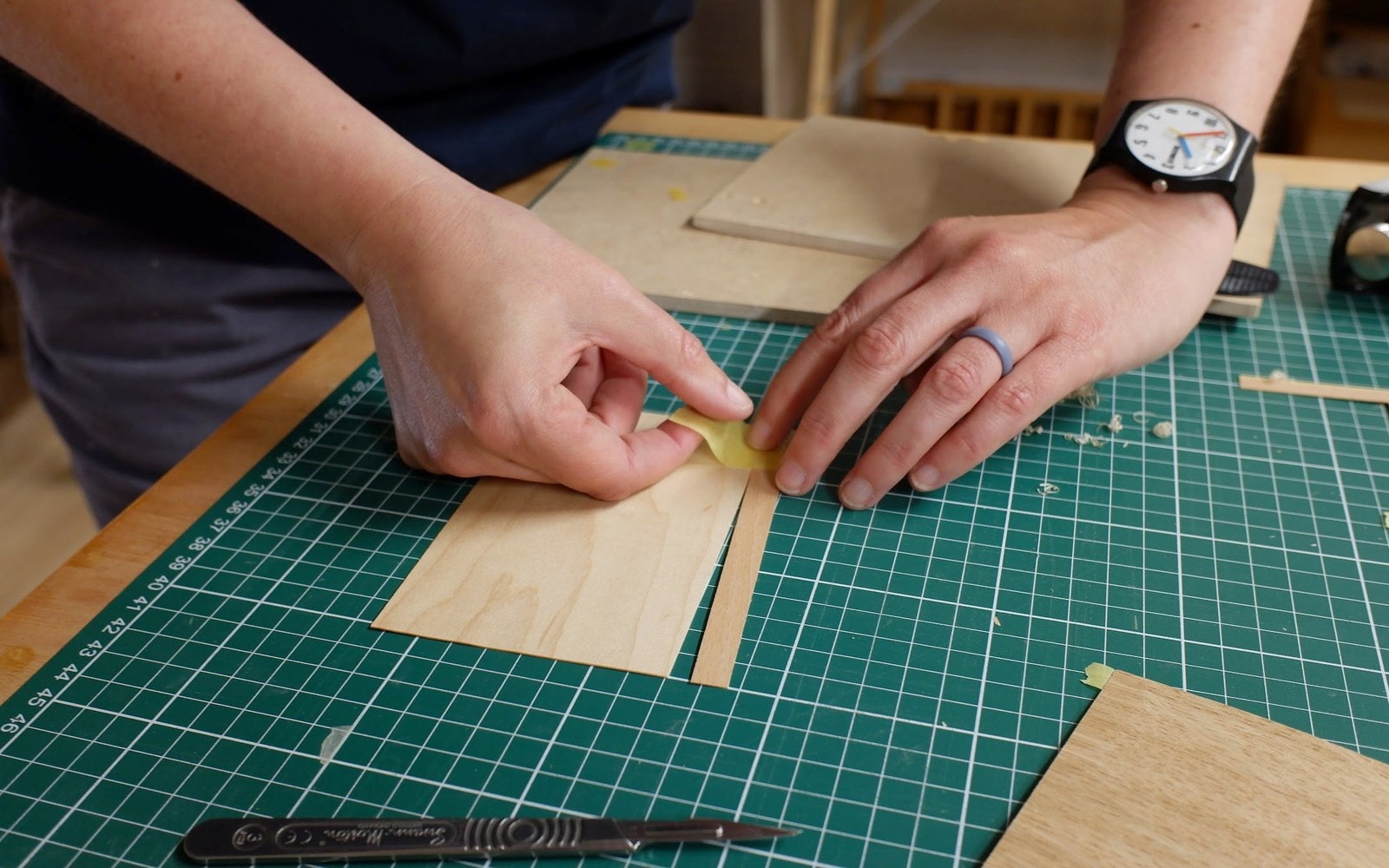
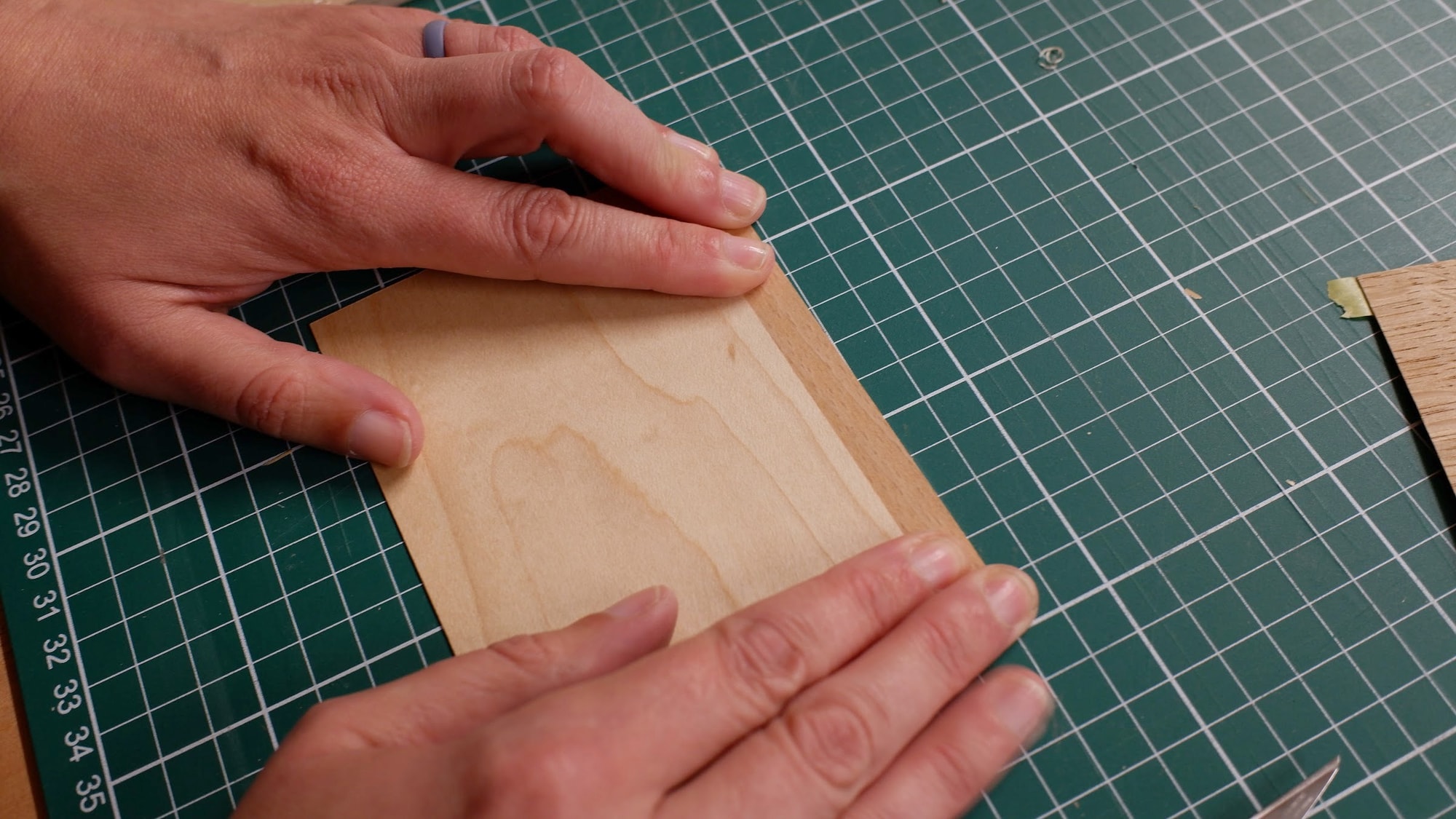
She starts with lots of small thumbnail sketches and then a full drawing, chooses the veneers for their tone and grain, and cuts each piece with a scalpel. She tapes the veneer before cutting it so it doesn't split, especially across the grain, and she gets through a lot of tape. The grain tries to pull the blade with it, so a cut that started on the line can wander off it. "Like, I was bang on the line there, but the cut is slightly off the line because the blade has wiggled a little bit to follow the grain." Each edge is then planed or sanded straight with a small block plane, and the pieces are taped together until there is no dark line at the join at all. "You basically want it to look like it is one piece," she said, while admitting that a gap is "irritating once you spot it though."
She looks for what she calls the cathedrals of the grain, the arched pattern in the middle of a board, and will cut from the centre of a veneer to get it. The finished design is pressed onto a stable board in a vacuum bag, and she edges it with a thin strip of solid wood afterwards, which hides the edges of the veneer so you only see the picture. "I don't have a laser cutter," she said, "so everything's cut by hand."
MARQUETRY WALL ART, AND THE STITCHING
Claire started making marquetry to hang on the wall because, as she put it, "not everybody needs, wants, can afford a giant piece of furniture with marquetry on it." Her designs are geometric and pared back, after early twentieth century modernism, and she frames each one in a solid oak frame she makes herself, so it arrives ready to hang. A small piece takes her about a day to cut and a couple of days to frame.
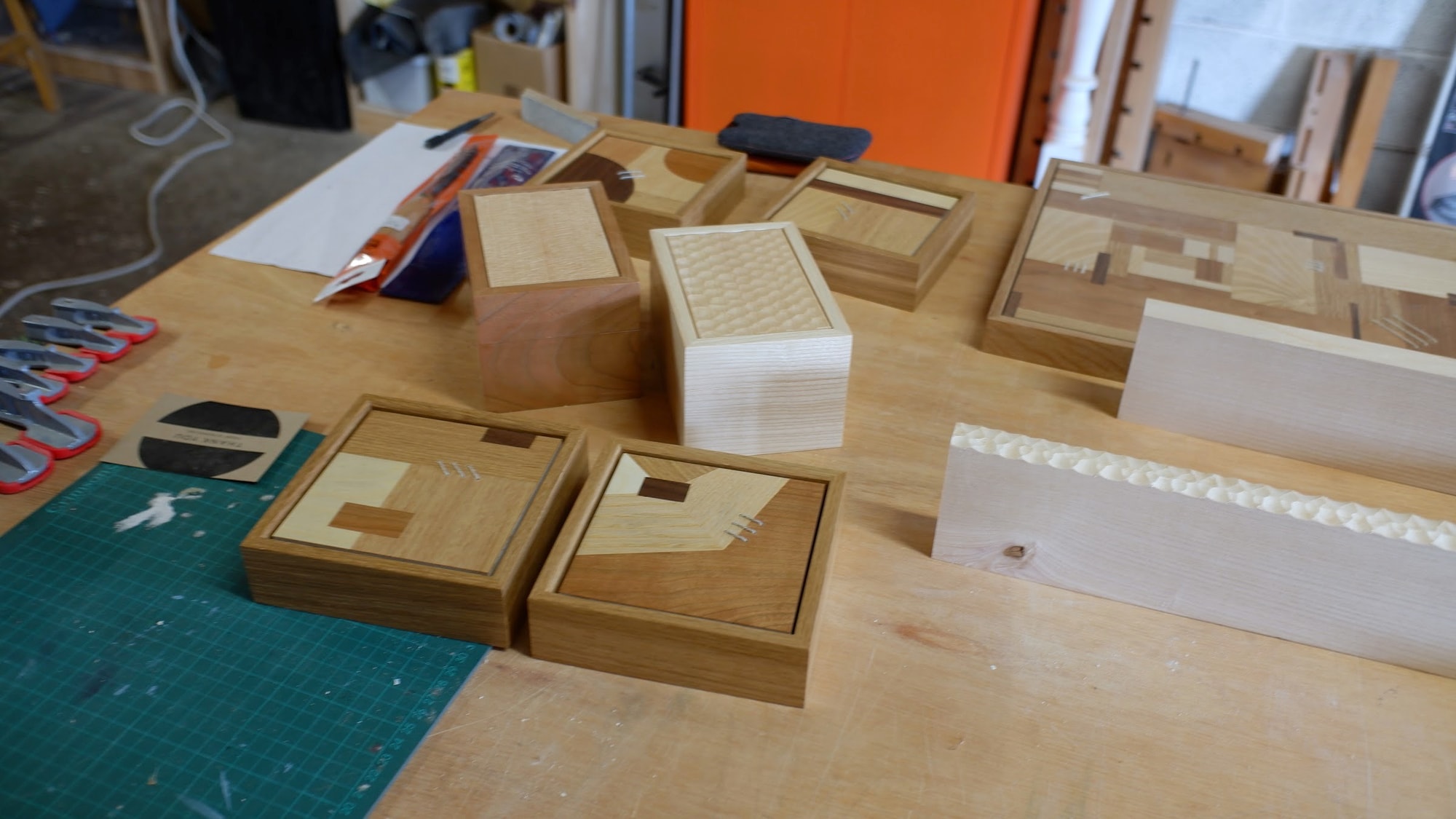
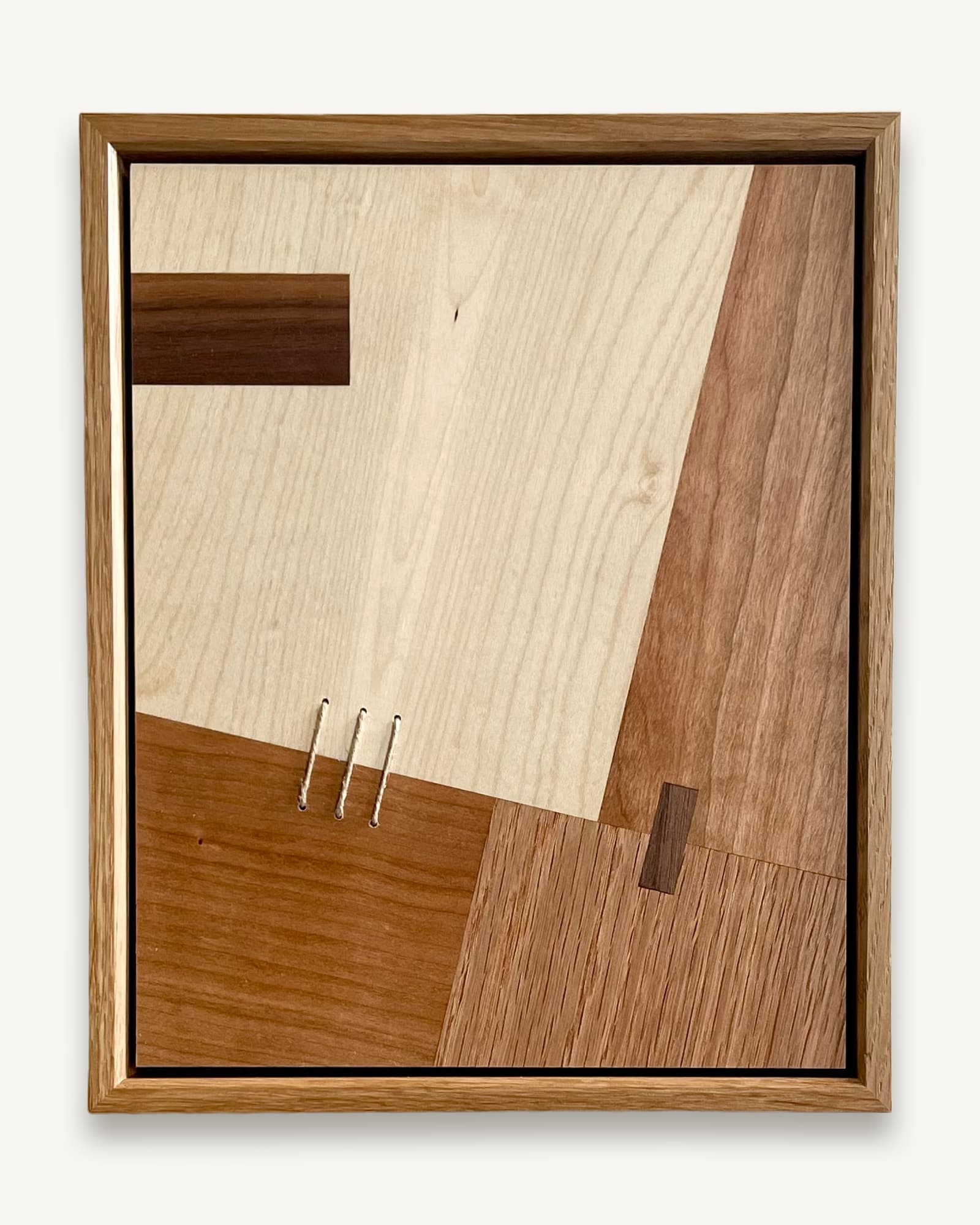
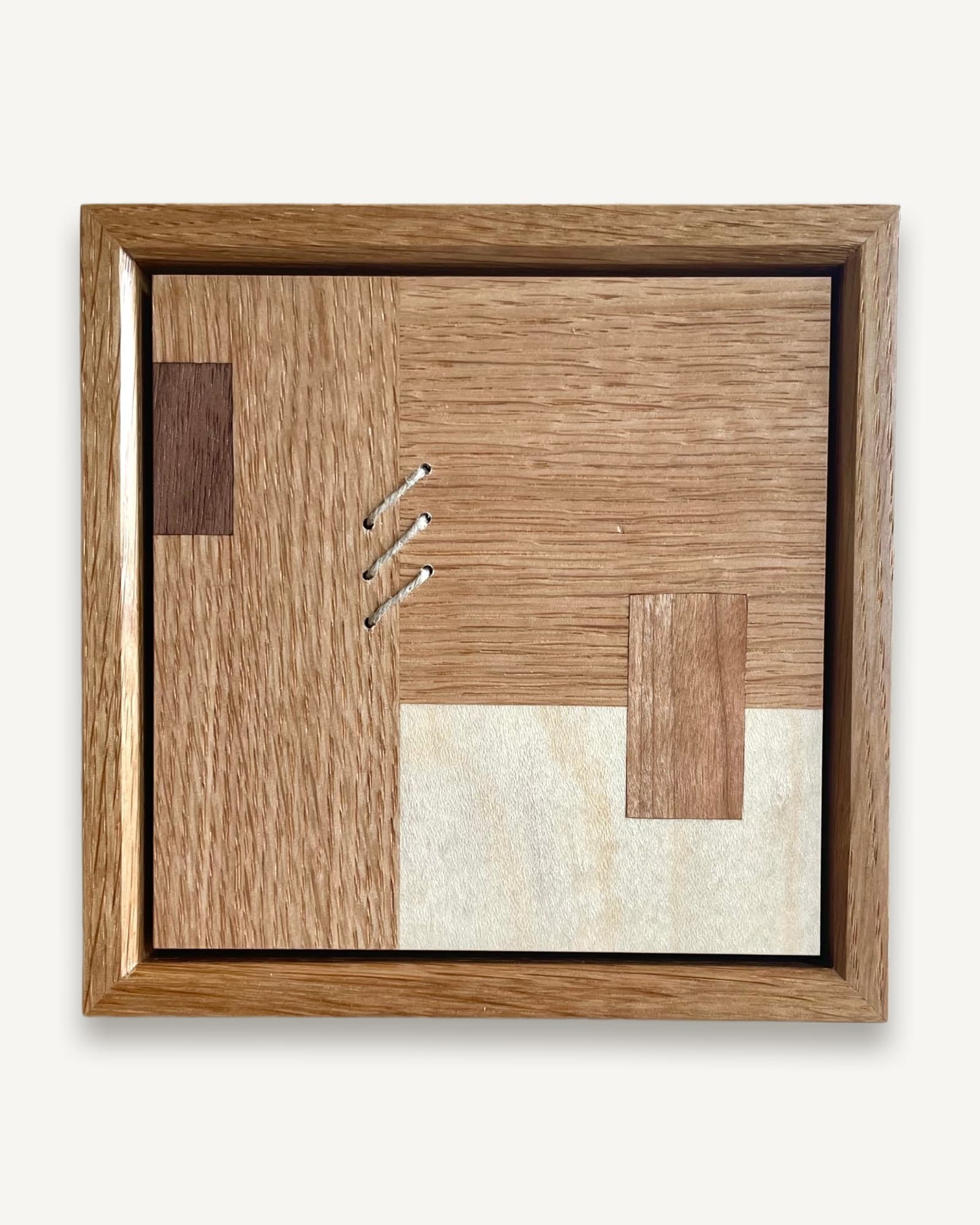
Some of them have lines of linen thread stitched through the wood. That started with the first piece she made in this workshop, which felt unfinished. She happened to have some thread to hand, laid a few lengths across it and liked what it did: "it plays with the light, the texture's different, the form is different." Now, once a panel is finished, she drills holes through it and stitches natural linen thread through by hand, but only where the design needs it. She doesn't know of anyone else doing it, though she is careful about saying so: "I'm sure somebody will tell me they did it in 1963, but right now I think it's unique."
Her larger stitched panel, Wall Art, Composition 1, combines oak, ash, cherry, walnut and sycamore in a 30 by 40 centimetre frame, and she makes pieces like it to commission from £500. She has recently started using dyed veneers too, which bring colour in alongside the natural wood.
HAND CARVED KEEPSAKE BOXES
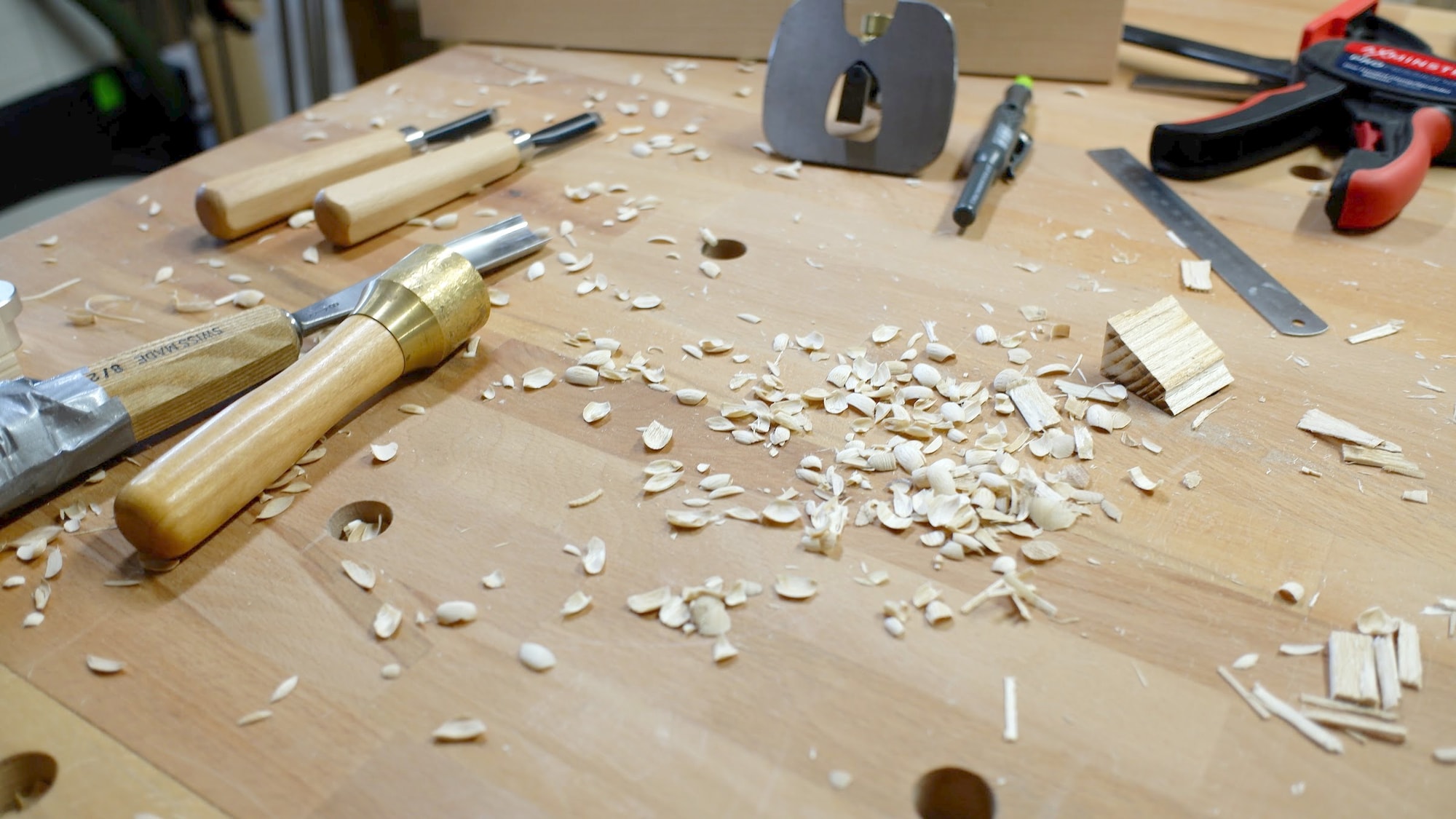
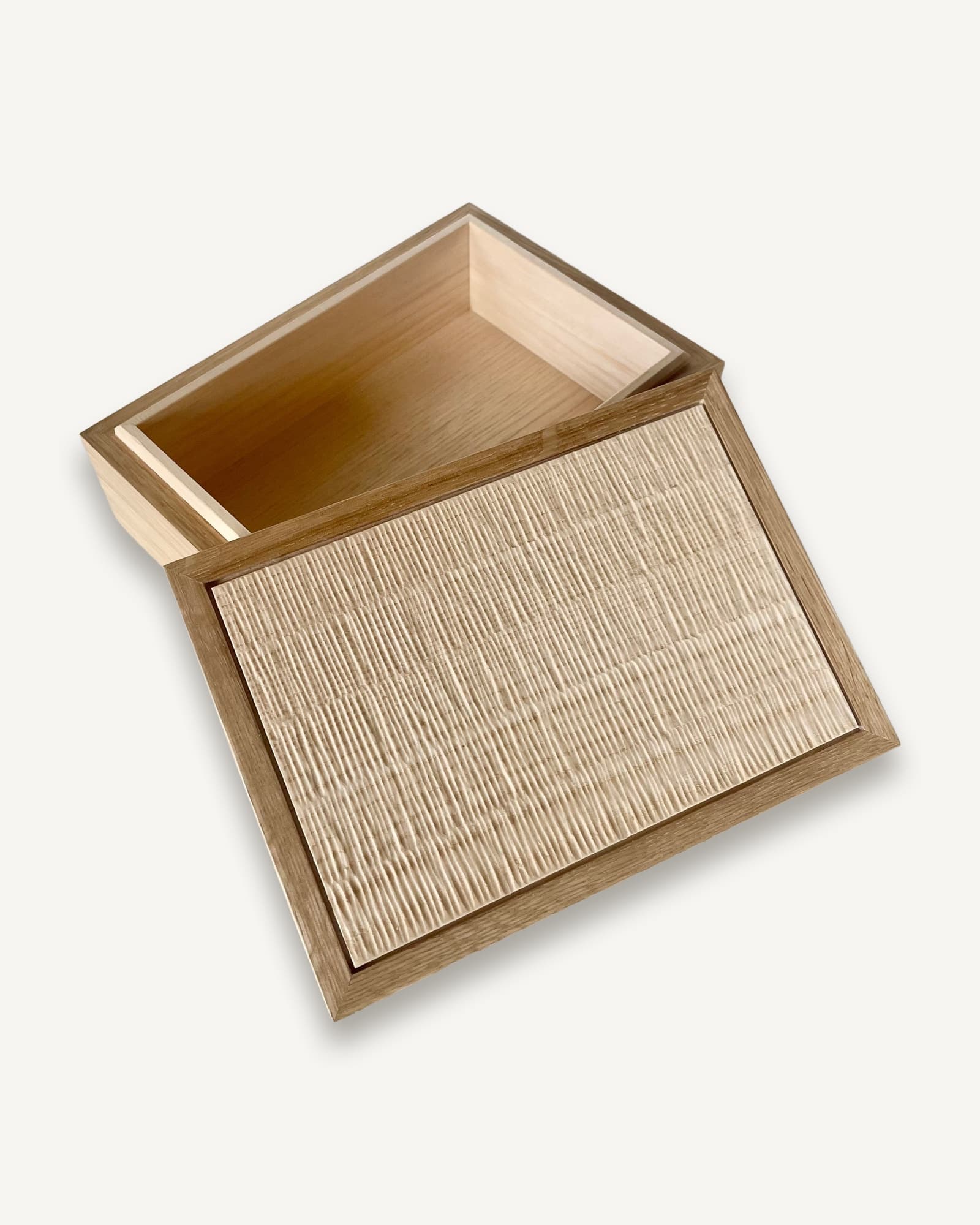
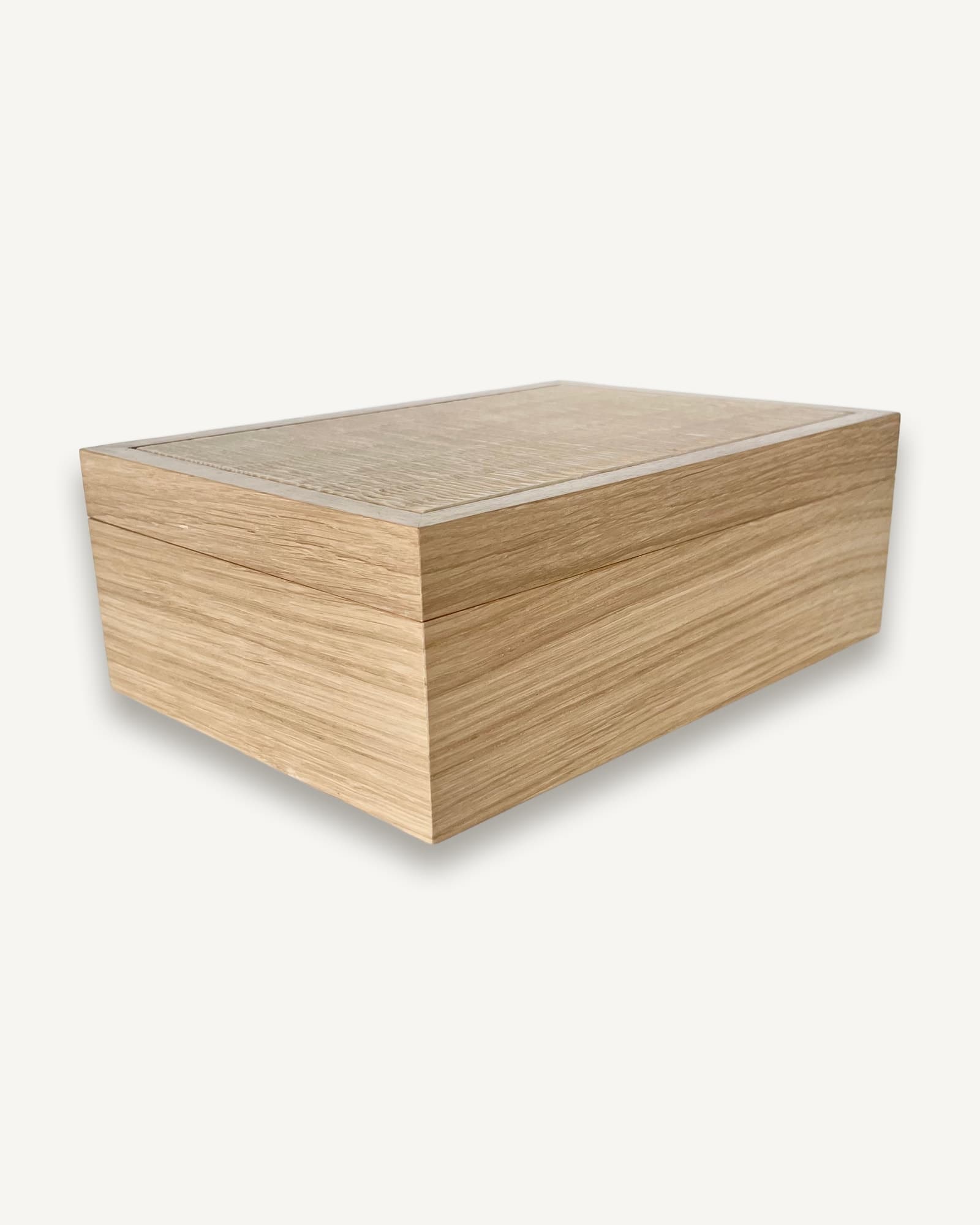
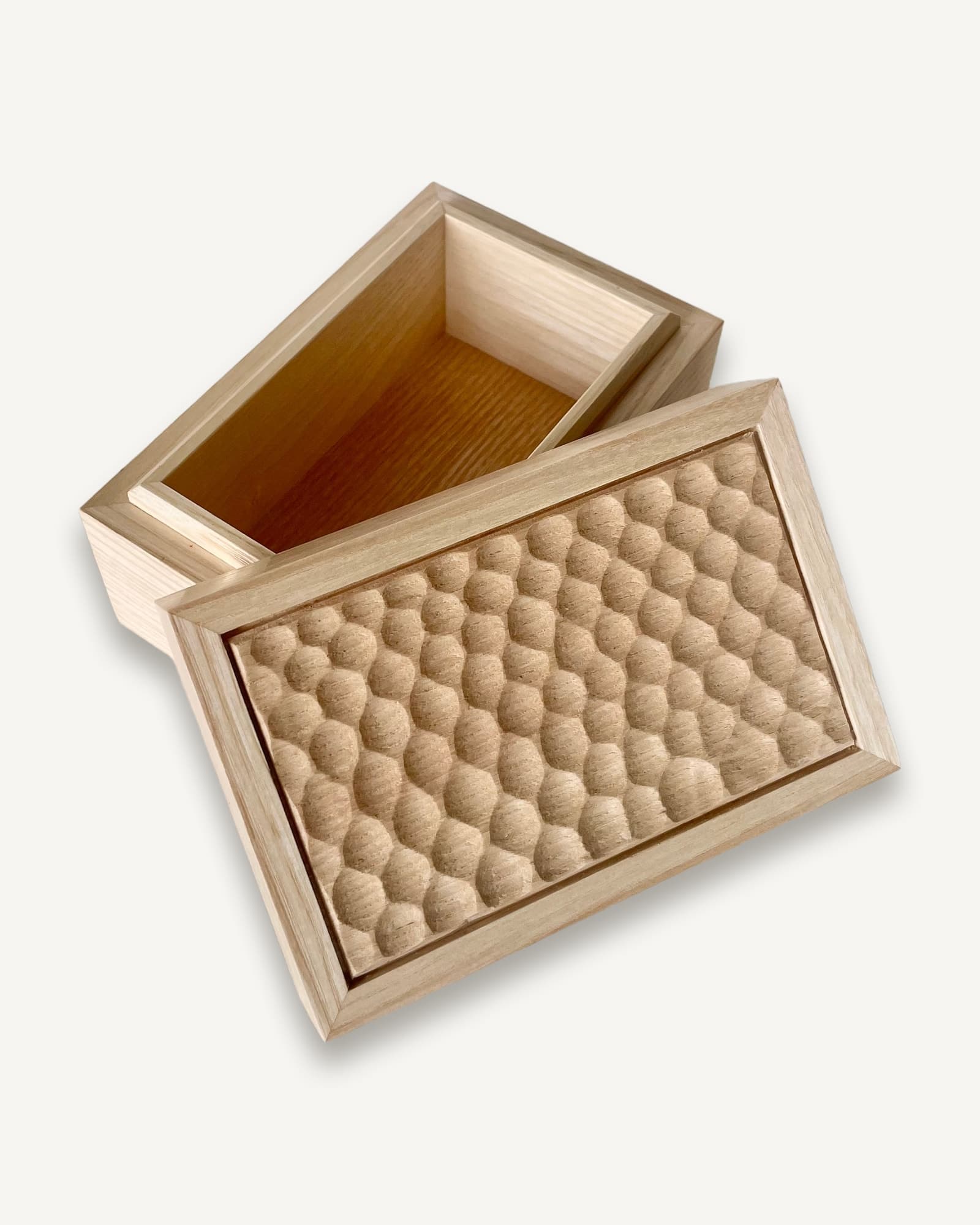
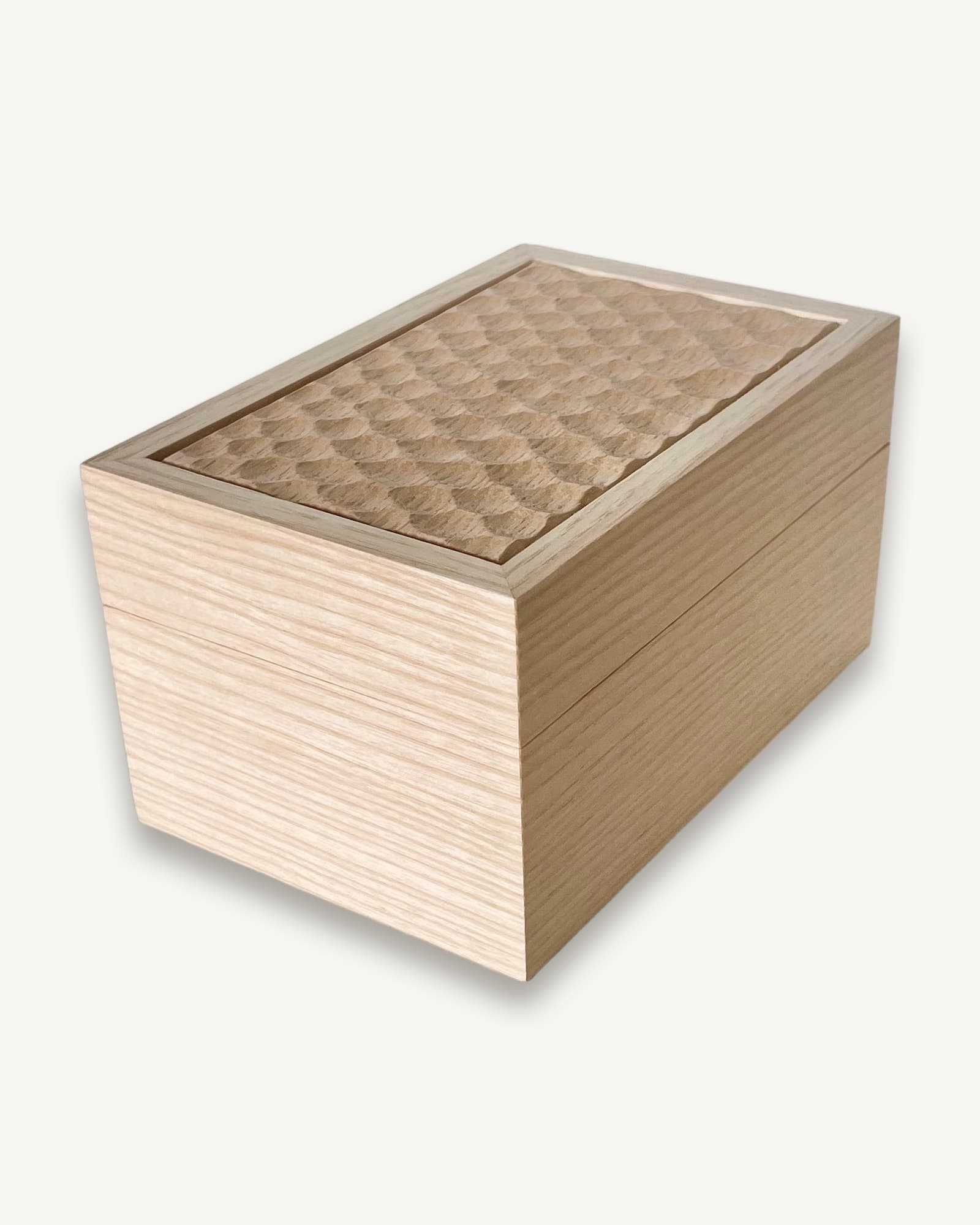
Claire's boxes are grain-wrapped, which means the corners are mitred so the grain runs unbroken round all four sides, and the lids are push fit and lined with wood, so they lift off with a soft pop and slide back on. The tops are carved by hand with a gouge and a small mallet. She lets the wood decide the pattern, following a swirly grain so it ends up looking "a bit like a Van Gogh painting, when he did his skies", or cutting across it to make divots that go through the layers and show different colours. Walnut shavings, she pointed out, "actually look like chocolate curls. These look like white chocolate curls."
She finishes them with beeswax rather than varnish, which she never uses ("never, never, never, never varnish"), because wax and oil soak into the wood and can be topped up, whereas varnish sits on the surface and eventually peels. If a box starts to look a bit thirsty, a little beeswax rubbed in brings it back.
WHAT CAN A BOX BE MADE FOR?
The boxes in her shop are oak, ash and cherry, but because she makes every one from scratch she can make them "at any size, dimension or timber to suit requests really." She has made them in sycamore too, and two were made from a 1960s sapele mantelpiece taken out of her home, because she didn't want to throw the wood away. As for what goes in them, people keep all sorts: "you might have a spare elastic band in it or you might have your most precious jewellery in it."
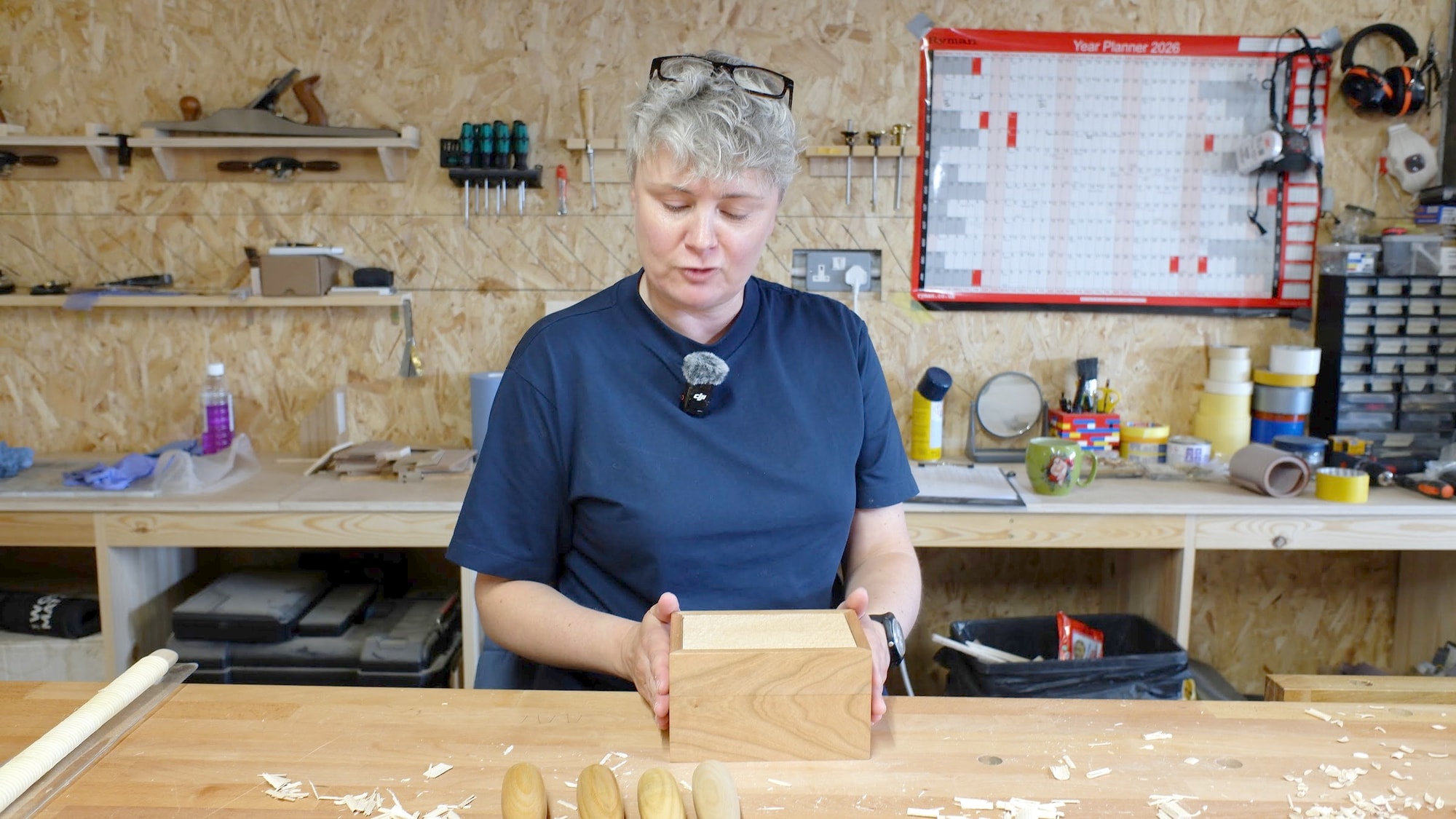
A box can be made to hold something specific. For a jewellery box she can add hinges and fit liners for rings and necklaces, and she has had an enquiry for a box to display a collection of pens. She gave a family medal or trophy, or a humidor for cigars, as examples of what a box could be made around. Because there is room for a present inside, she thinks they make a good anniversary gift too. Her Oak and Walnut Box, dovetailed in oak with a carved walnut lid, gives an idea of a commissioned box. Boxes start from £280, and this one costs more because of its dovetails.
HOW DO YOU COMMISSION A PIECE FROM CLAIRE BROAD?
You start by telling her what you have in mind, the space it is for and your budget, through the enquiry button on any of her commission pieces, which is free and comes with no obligation, and she then works through the design with you in three stages.
The first is a sketch. She works on paper before anything else and always has two or three notebooks on the go: "it starts with a design. So it starts with a sketch."
The second is a 3D drawing on the computer. "Once people are happy with the sketch, I'll then draw it up on a computer program so that we've actually got a proper 3D model of it." This is the point where you can see how the piece will sit in the room before any wood is cut, which matters because, as she says, "it's a big commitment from a financial point of view."
The third is the timber, finish and detail, where you decide on the wood and the feel of the piece, whether it is dark or light, sleek or traditional, and whether the joinery shows. Your budget decides where the work goes. "If the focus is going to be a marquetry front, maybe we pare back the joinery so that the focus is on the marquetry. If the front is a plain timber front, maybe we add the dovetails down the side to add a little bit more visual interest."
Her commission pages give a starting price and a typical lead time for each kind of piece: from £280 and around 60 days for a box, from £500 and 60 days for a side table like the Ridge Table or for a marquetry wall piece, from £4,000 and 90 days for a pair of bedside tables, and from £12,000 and around 150 days for a piece like the Stacks Console. The making alone is a couple of days for a box and two to three months for a bedside table, "depending on, again, the complexity." The final price depends on the size, timber and finish you agree together.
WHAT SHE LIKES TO MAKE
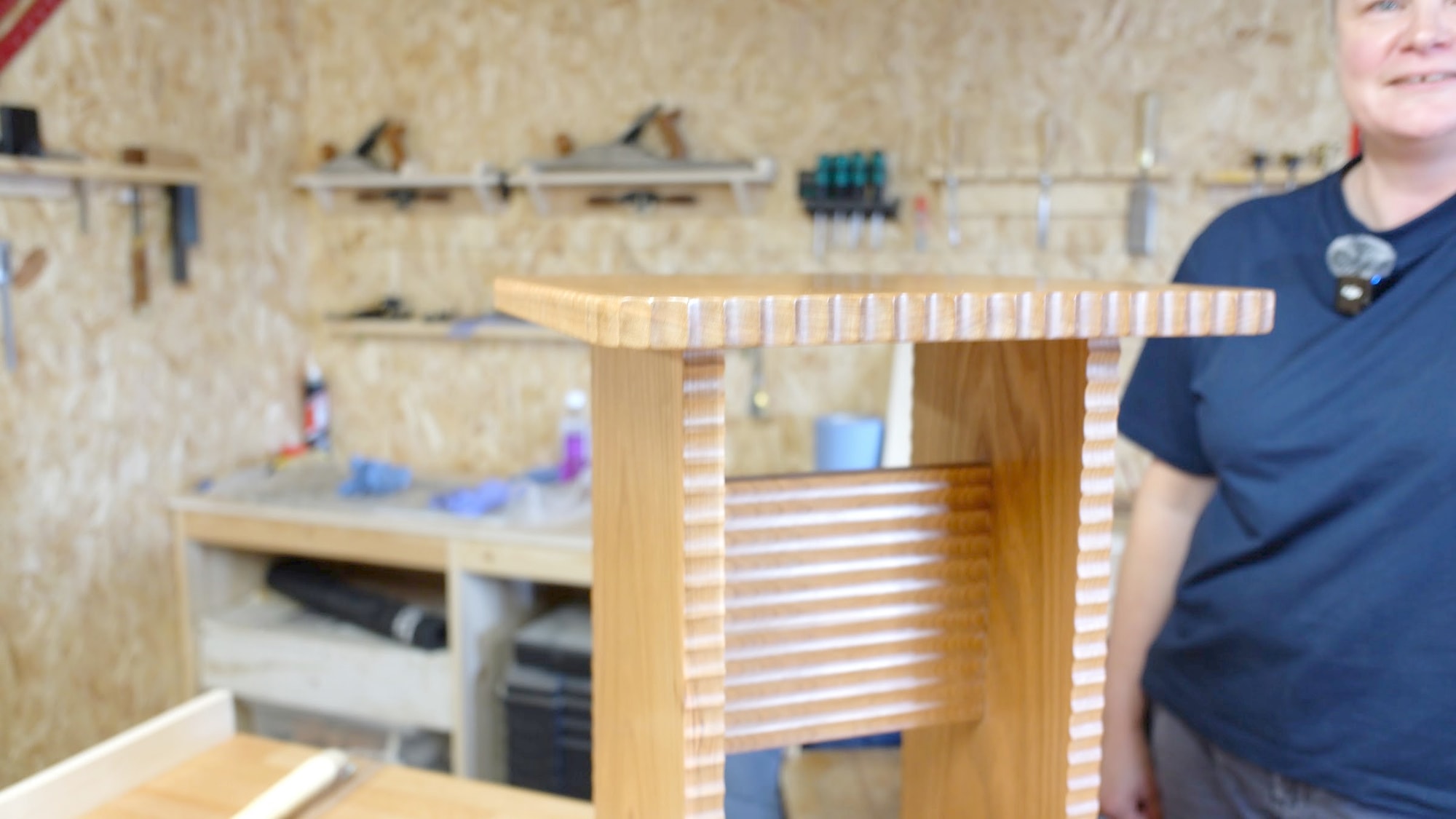
Claire works alone, so she keeps to smaller furniture: side tables, bedside tables, console tables, small cabinets and drinks cabinets. She likes side tables because "people can feel a bit more playful" with something that doesn't dominate a room, and drinks cabinets because they can be made to fit around a collection. Her Ridge Table is solid cherry with scalloped edges carved by hand, cut from the centre of each board so the grain shows on every leg, and finished in hardwax oil, and she chose cherry partly because it darkens and reddens as it ages. She uses dovetails wherever she can, partly because people can't stop running their hands along them, and drawers can be fitted traditionally, so they close on a cushion of air, or on soft-close runners.
She admits to being "sadly a bit of a perfectionist, which for furniture is a good thing." At the moment there is a slab of local ash drying in the machine shop, from a tree that grew about two miles away and was milled last year. She hopes it will be ready to use by next summer. Next on her bench is a cocktail cabinet in oak and sycamore, and you can see her pieces and send her an enquiry on her maker page.
Pictures: taken at Claire Broad's workshop, 1 October 2026. Marquetry status from Heritage Crafts, Red List of Endangered Crafts, 2025 edition.
Pieces by Claire Broad Design
More stories like this
One thoughtful email a month, not a marketing torrent. New makers, seasonal edits, and the stories behind the craft.
How we look after your details: privacy policy