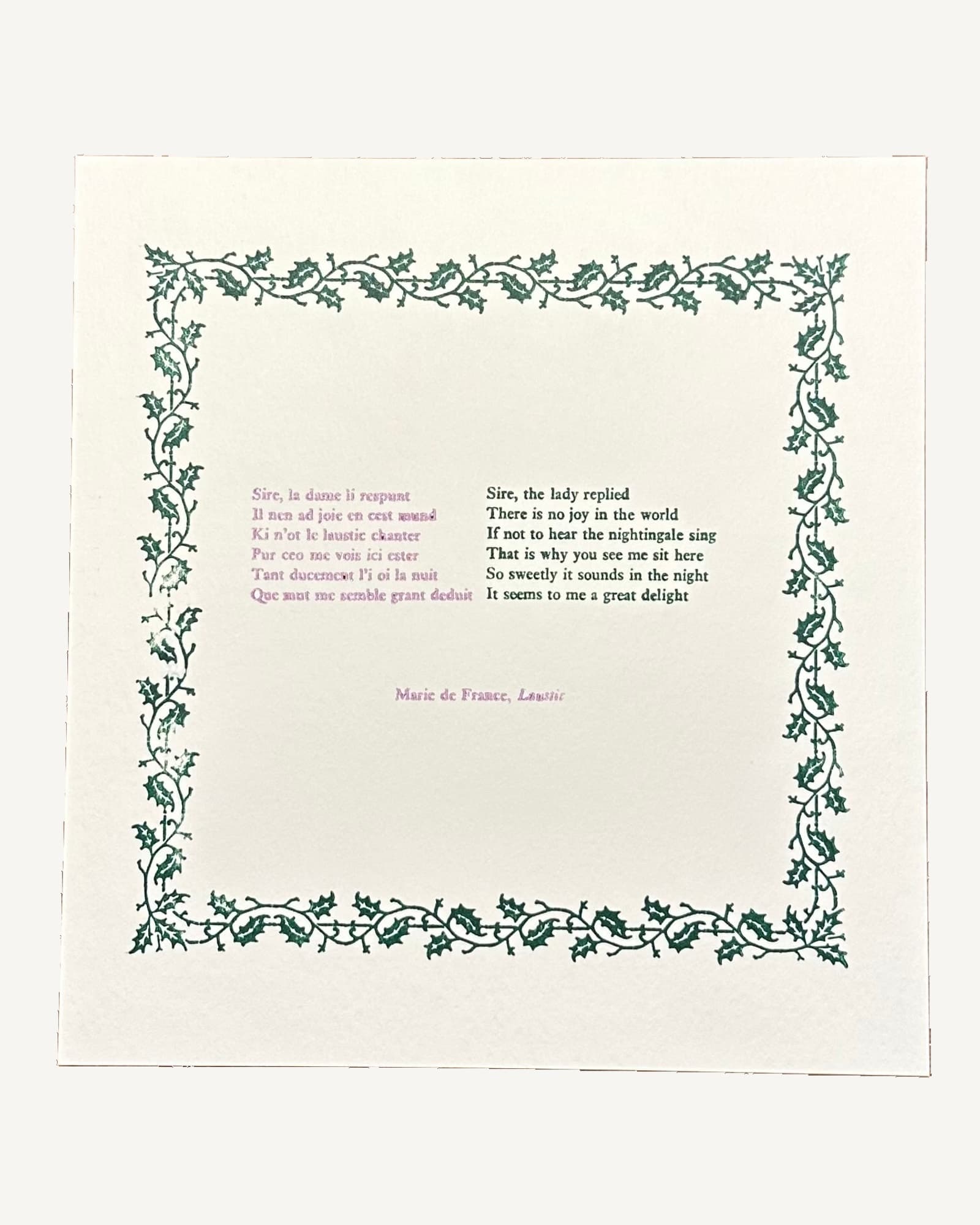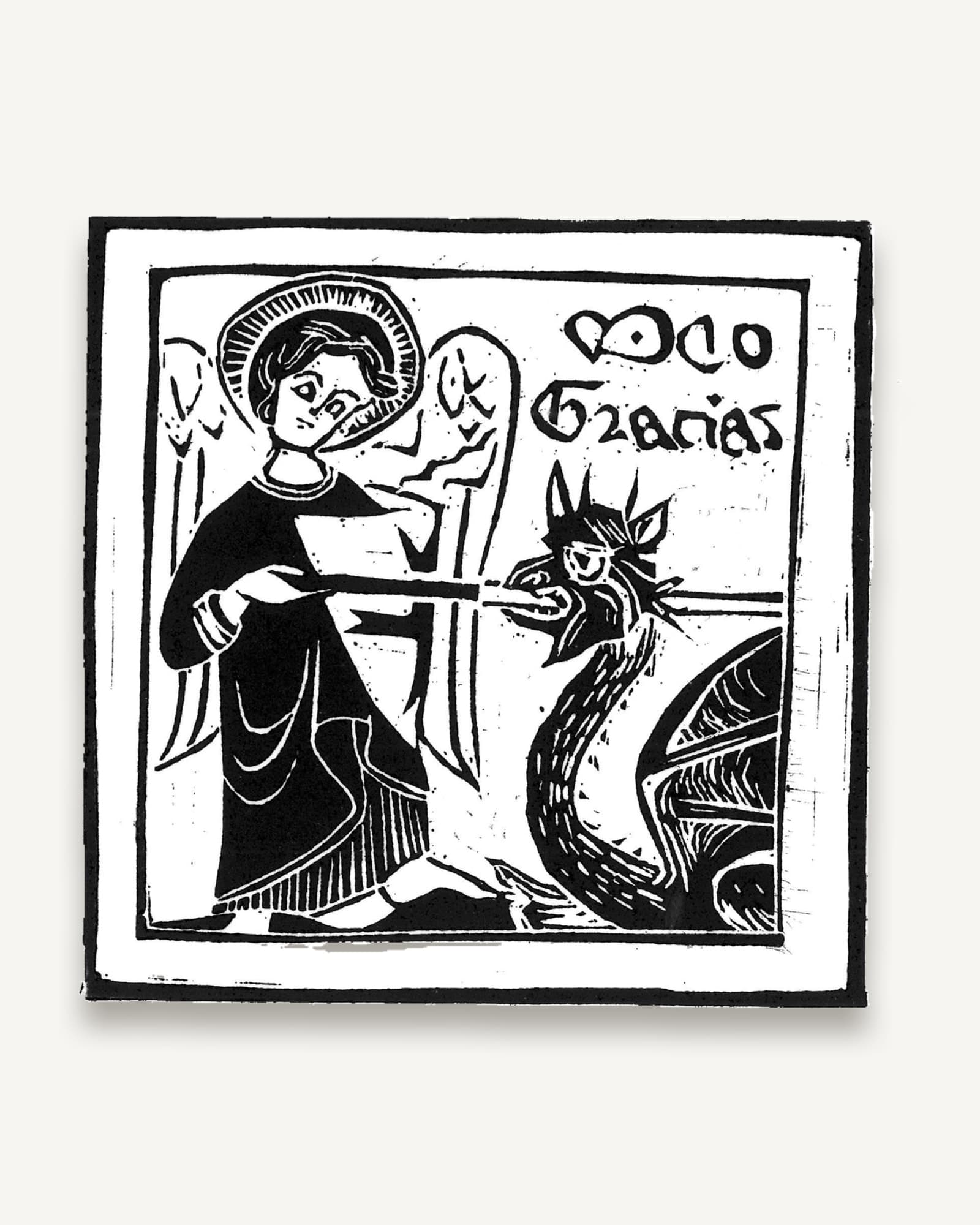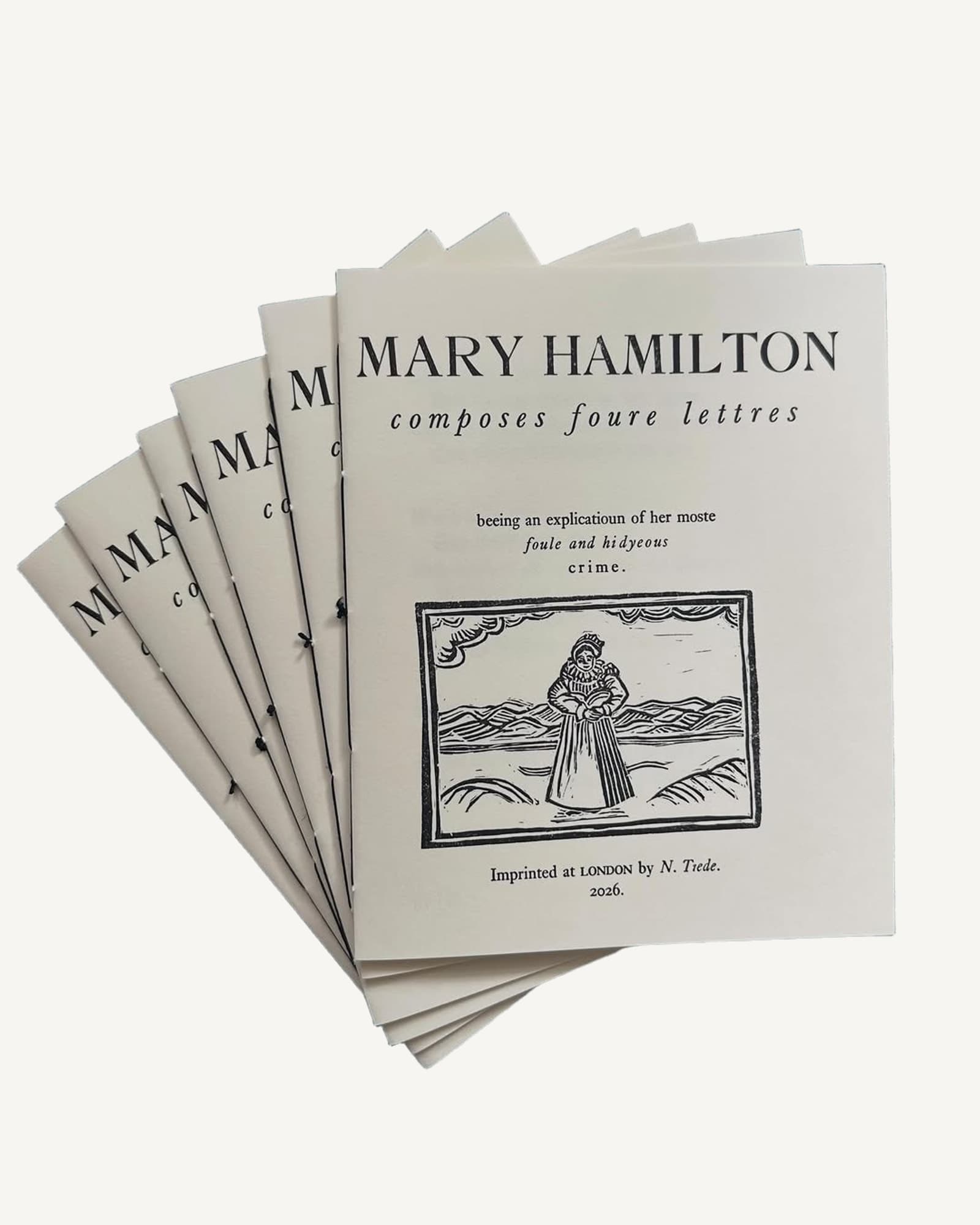
Four short stories in the form of letters, printed on cream laid paper and sewn by hand with black thread. Each opens with a block-printed illustration on the left and its first page of text on the right, and the title page announces itself the way a seventeenth-century crime sheet would: beeing an explicatioun of her moste foule and hidyeous crime.
The ballad behind it is Mary Hamilton, number 173 in Francis Child's collection. A lady-in-waiting at the Scottish court bears the king's child, is condemned for its death, and goes to the scaffold naming the three women who shared her name: Mary Beaton, Mary Seton, Mary Carmichael, and me. The song lets her speak only at the end, on the road to her execution.
Natalie's letters give her a voice earlier and in private. They are addressed to the queen and to the other three Maries, written from inside the household rather than from the scaffold, where sharing a name with every woman in the room has stopped being a refrain and become a difficulty.
The woman herself may never have existed. Mary Queen of Scots' real attendants were Seton, Beaton, Fleming and Livingston, and the likeliest source for the song is a Scot named Mary Hamilton executed at the court of Peter the Great in 1719. The letters are written for someone who was already an invention.
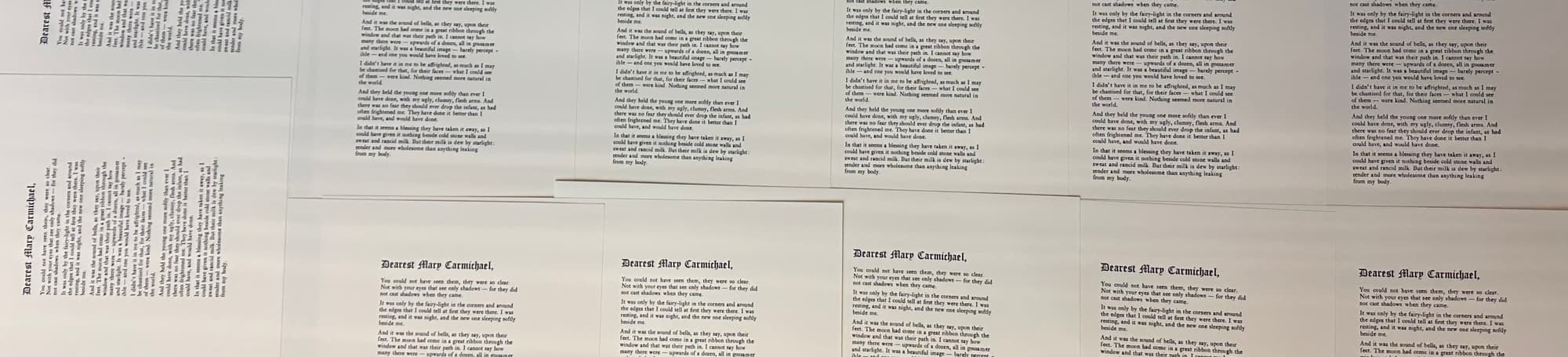
Natalie set every line of it by hand in metal type, at roughly six hours to the page: the ballad in blackletter, the letters in 10pt Ehrhardt, a Monotype face of 1938 that goes back to Dutch types cut in Amsterdam in the 1680s. The type itself came out of London presses that have long since closed. She printed it hard enough that the letters bite into the paper and catch the light across the page.
Chapbooks like this one were the cheapest print there was, sold for pennies and meant to be thrown away, which is how the ballad survived at all. This one is made to be kept. The title page carries her imprint, Imprinted at LONDON by N. Tiede. The paper is uncoated, so it marks if it gets damp and holds its colour best out of direct sun.
 Natalie Tiede
Arrives Sat 24 Oct, UK delivery from £3.02
Four short stories in the form of letters, printed on cream laid paper and sewn by hand with black thread. Each opens with a block-printed illustration on the left and its first page of text on the right, and the title page announces itself the way a seventeenth-century crime sheet would: beeing an explicatioun of her moste foule and hidyeous crime.
The ballad behind it is Mary Hamilton, number 173 in Francis Child's collection. A lady-in-waiting at the Scottish court bears the king's child, is condemned for its death, and goes to the scaffold naming the three women who shared her name: Mary Beaton, Mary Seton, Mary Carmichael, and me. The song lets her speak only at the end, on the road to her execution.
Natalie's letters give her a voice earlier and in private. They are addressed to the queen and to the other three Maries, written from inside the household rather than from the scaffold, where sharing a name with every woman in the room has stopped being a refrain and become a difficulty.
The woman herself may never have existed. Mary Queen of Scots' real attendants were Seton, Beaton, Fleming and Livingston, and the likeliest source for the song is a Scot named Mary Hamilton executed at the court of Peter the Great in 1719. The letters are written for someone who was already an invention.
Natalie set every line of it by hand in metal type, at roughly six hours to the page: the ballad in blackletter, the letters in 10pt Ehrhardt, a Monotype face of 1938 that goes back to Dutch types cut in Amsterdam in the 1680s. The type itself came out of London presses that have long since closed. She printed it hard enough that the letters bite into the paper and catch the light across the page.
Chapbooks like this one were the cheapest print there was, sold for pennies and meant to be thrown away, which is how the ballad survived at all. This one is made to be kept. The title page carries her imprint, Imprinted at LONDON by N. Tiede. The paper is uncoated, so it marks if it gets damp and holds its colour best out of direct sun.
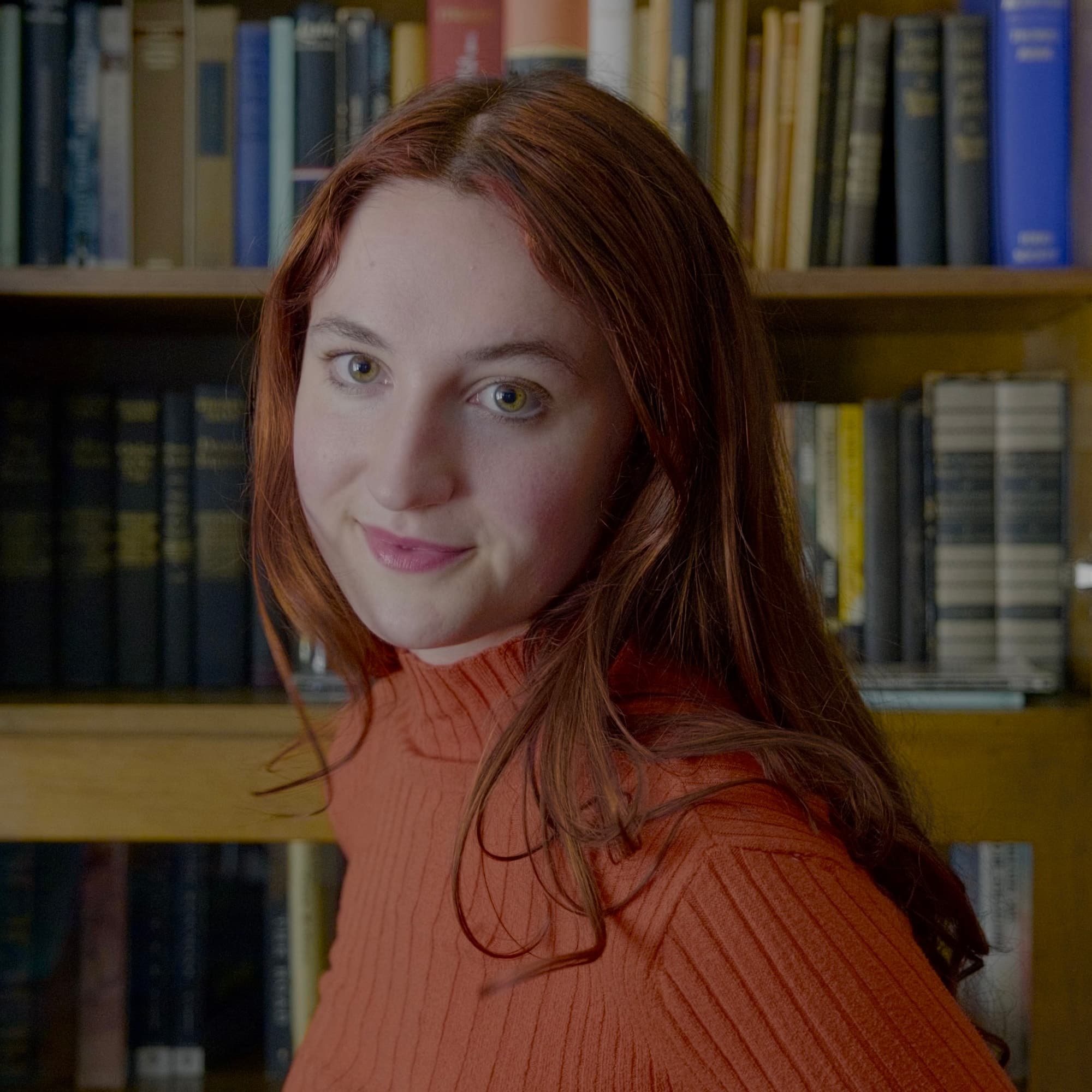
Natalie is a typesetter and letterpress printer, working with metal type and other forms of relief printing. As a student of medieval literature at university, she has been interested in early bookmaking practices. Her work is inspired by historical print culture, especially broa
Natalie is a typesetter and letterpress printer, working with metal type and other forms of relief printing. As a student of medieval literature at university, she has been interested in early bookmaking practices. Her work is inspired by historical print culture, especially broa